
BOM Calculator for Electronic Products
FREE HARDWARE COSTING TOOL
Estimate component purchasing costs, PCB expenses, assembly, testing, packaging, logistics and one-time engineering costs for your hardware product.
Build your BOM using your own supplier prices and production assumptions to estimate purchasing requirements, recurring product cost and fully loaded cost per finished unit.
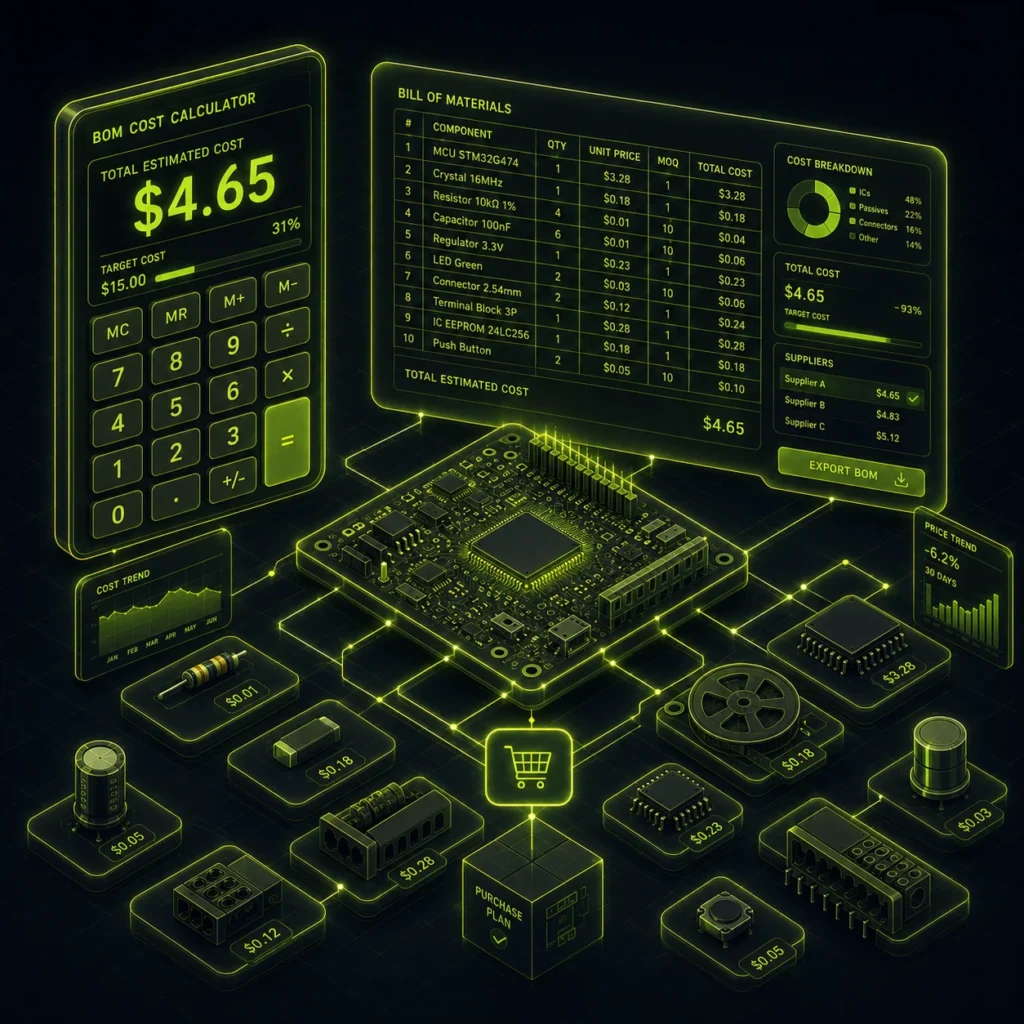
Plan Your Hardware Costs Before Production
Electronic product cost is more than the sum of component prices. Minimum order quantities, scrap allowances, PCB fabrication, assembly, programming, testing, packaging, freight, setup charges and engineering costs can significantly affect the real cost of a production run.
The Devoforge BOM Calculator helps you organize these costs in one place so you can create a more realistic preliminary estimate before requesting supplier quotations or committing to production.
It also separates the amount you may need to spend on purchased components from the value of materials actually consumed by the production batch. This is especially useful when supplier minimum order quantities or order multiples leave you with excess inventory.
Note: Calculator results are preliminary planning estimates only. Actual component prices, supplier terms, duties, manufacturing yields, freight charges and production costs may vary.
Understand More Than Just Component Cost
A hardware product may contain inexpensive individual components but still become costly once manufacturing, minimum order quantities and one-time development expenses are included.
A structured BOM cost estimate can help you:
- Understand the expected cost of your production batch
- Identify expensive components
- See the impact of supplier MOQ requirements
- Estimate excess inventory
- Include PCB fabrication and assembly costs
- Include testing and programming expenses
- Account for packaging and logistics
- Allocate one-time engineering and tooling costs
- Estimate a realistic cost per finished product
- Compare product cost with your target selling price
The earlier these costs are understood, the easier it becomes to make informed design, sourcing and manufacturing decisions.
How the BOM Calculator Works?
Build your preliminary product-cost estimate in four main steps.
01 — Set Your Production Quantity
Enter the number of finished products you plan to manufacture. The calculator uses this quantity to determine required component quantities, PCB requirements and per-unit manufacturing costs.
03 — Add Manufacturing Costs
Include other costs required to produce the finished product, such as:
- PCB fabrication
- SMT assembly
- Through-hole assembly
- Programming
- Functional testing
- Inspection
- Enclosures
- Packaging
- Freight
- Import-related costs
02 — Build Your Component BOM
Add each electronic component used in one finished product.
Enter information such as:
- Component name
- Manufacturer part number
- Quantity per product
- Unit price
- Scrap allowance
- Supplier order multiple
- Minimum order quantity
04 — Add One-Time Costs and Review Your Estimate
Add optional non-recurring engineering costs such as:
- Product engineering
- Electronics design
- PCB design
- Firmware development
- Mechanical design
- Prototype development
- Certification
- Tooling
BOM Calculator
Enter your production quantity, component prices and manufacturing costs to calculate an estimated cost for your electronic product.
Project Settings
Set the main production assumptions used by the calculator.
Electronic Components
Add every electronic component required for one finished product.
| Component | MPN | Qty / Unit ⓘ | Unit Price | Scrap % ⓘ | MOQ ⓘ | Order Multiple ⓘ | Purchase Qty | Line Cost |
|---|
PCB Fabrication
Add bare PCB fabrication and applicable setup charges.
Assembly & Programming
Add only the assembly processes that apply to your product.
Testing & Quality
Include applicable per-unit testing and fixed test setup costs.
Mechanical & Packaging
Include the physical product and packaging costs associated with each finished unit.
Freight & Landed Costs
Add shipping and estimated import-related expenses for the batch.
One-Time Engineering & Tooling Costs
Add non-recurring costs if you want to calculate a fully loaded product cost.
Export / Share BOM
Download your BOM data, create a printable report or copy the table for use in Excel, Google Sheets and other project tools.
BOM Cost Breakdown
Review the estimated cost contribution from each stage of your product manufacturing process.
Detailed Cost Breakdown
| Cost Category | Batch Total | Per Finished Unit |
|---|---|---|
| Electronic Components | $0.00 | $0.00 |
| PCB Fabrication | $0.00 | $0.00 |
| Assembly & Programming | $0.00 | $0.00 |
| Testing | $0.00 | $0.00 |
| Mechanical | $0.00 | $0.00 |
| Packaging | $0.00 | $0.00 |
| Freight & Landed Costs | $0.00 | $0.00 |
| Recurring Production Cost | $0.00 | $0.00 |
| NRE Allocation | $0.00 | $0.00 |
| Fully Loaded Cost | $0.00 | $0.00 |
Cost Distribution
BOM Insights
Automatic observations based on the values entered into your BOM.
FAQ's
What is a BOM calculator?
A BOM calculator helps estimate the material and manufacturing costs associated with producing an electronic product based on its bill of materials and production assumptions.
What does BOM mean?
BOM stands for Bill of Materials. It is a structured list of the components, parts and materials required to manufacture a product.
Does the calculator include minimum order quantities?
Yes. You can enter the MOQ for each component so the estimated purchasing quantity reflects supplier minimum-order requirements.
What is an order multiple?
An order multiple is the quantity increment in which a supplier sells a component. For example, if the order multiple is 100 and you need 1,020 components, you may need to purchase 1,100.
Why are component purchase cost and component usage cost different
The purchasing cost reflects the quantity you may actually need to buy from suppliers. The usage cost represents the estimated value of components required for the current production batch. The two values can differ when supplier MOQ or order multiples force you to buy additional inventory.
What does Global Component Scrap % mean?
It is an extra component allowance added to cover expected loss, damage, assembly defects or production wastage. The global percentage applies to BOM rows where you have not entered a separate scrap percentage..
What does NRE mean?
NRE means Non-Recurring Engineering. These are one-time development costs such as electronics design, PCB design, firmware development, prototyping, certification and tooling.
What is NRE amortization quantity?
It is the number of products across which you want to distribute your one-time engineering and tooling costs. For example, if NRE is $20,000 and you expect to manufacture 10,000 units, the allocated NRE would be $2 per unit.
What is recurring cost per unit?
Recurring cost per unit is the estimated manufacturing cost associated with one finished product before allocation of one-time engineering and tooling costs.
What does Global Component Scrap % mean?
It is an extra component allowance added to cover expected loss, damage, assembly defects or production wastage. The global percentage applies to BOM rows where you have not entered a separate scrap percentage.
What is fully loaded cost per unit?
Fully loaded cost includes the recurring unit cost plus the selected allocation of NRE and tooling costs.
How is the suggested selling price calculated?
The calculator uses your fully loaded unit cost and selected target gross margin. The formula is: Selling Price = Fully Loaded Unit Cost ÷ (1 − Gross Margin)
Can I include PCB fabrication costs?
Yes. You can enter PCB price per board, scrap percentage, MOQ, order multiple and setup costs.
Can I include assembly and testing?
Yes. The calculator includes fields for SMT assembly, through-hole assembly, programming, functional testing, ICT, burn-in, inspection and test setup.
Can I include packaging and freight?
Yes. Packaging, freight, insurance, brokerage and estimated import duty can all be included.
Does Devoforge provide automatic component prices?
No. This version requires you to enter your own supplier or distributor prices manually.
Are the results a formal manufacturing quotation?
No. Results are preliminary planning estimates only. Actual costs depend on supplier quotations, component availability, manufacturing yield, product specifications, quantities, shipping terms, taxes, duties and other project-specific factors.