
Engineering Templates for Hardware & Embedded Product Development
FREE ENGINEERING TEMPLATES
Download practical, editable templates for requirements, system architecture, hardware and firmware design, BOM management, engineering risk, verification and validation, IoT integration, PCB reviews, manufacturing RFQs, and production handoff.
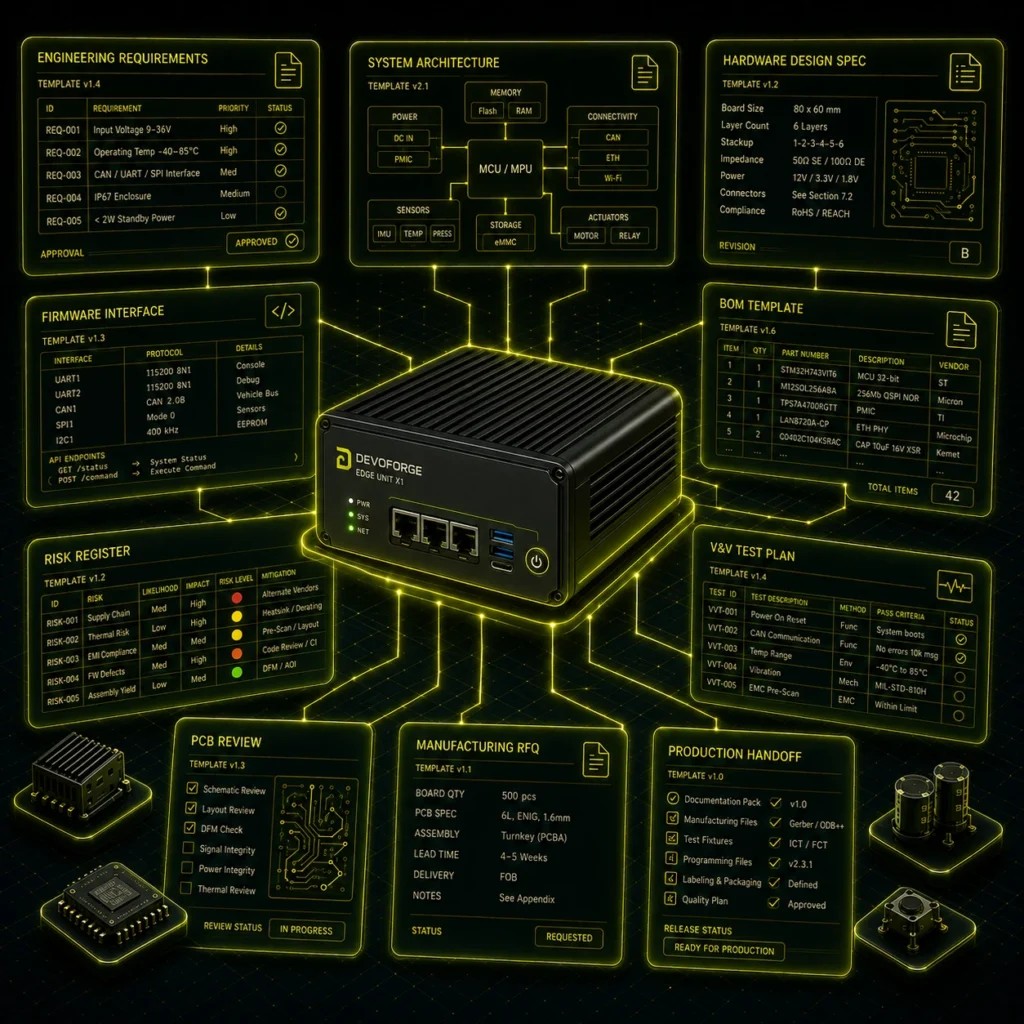
Engineering Templates for Hardware & Embedded Product Development
Download practical Devoforge documents and spreadsheets for requirements, system architecture, hardware and firmware design, BOM management, risk control, verification, IoT integration, PCB reviews, supplier RFQs and production handoff.
Find the Right Engineering Template
Search by document name, technical topic, project stage or file format.
Featured Engineering Templates
Strong starting points for documenting the core engineering lifecycle.
All Engineering Templates
No matching engineering templates found
Try removing a filter or searching with a broader hardware-development term.
Use Templates Across the Hardware Development Lifecycle
The templates are designed to work together. Start with requirements, create architecture and design baselines, control risks and sourcing, collect verification evidence, and prepare a traceable manufacturing handoff.
Start with Requirements & Architecture
Define what the product must achieve before recording how hardware, firmware, connectivity, mechanical and software subsystems will satisfy those needs.
Keep Decisions Traceable
Connect requirements, design decisions, risks, BOM revisions, tests, review findings and supplier information using controlled IDs, revisions and evidence references.
Prepare a Releasable Production Baseline
Before manufacturing, align the controlled BOM, design files, firmware, test evidence, supplier scope, quality controls and handoff documentation.
Templates Are Starting Points—Tailor Them to Your Product
Every hardware project has different technical, regulatory, commercial and manufacturing requirements. Adapt each template to the product, remove sections that do not apply, add project-specific controls, and verify critical decisions using current engineering evidence.
Identify the exact product, hardware, firmware and document revisions the template applies to.
Replace instructional placeholders and keep unresolved TBD/TBC items visible with owners and closure plans.
Link important decisions to requirements, calculations, simulations, test evidence, datasheets or supplier records.
Apply additional safety, compliance, quality or industry-specific controls where the product requires them.
FAQ's
What are Devoforge engineering templates?
Devoforge engineering templates are editable documents and spreadsheets designed to help hardware and embedded-development teams structure requirements, technical decisions, reviews, verification evidence, sourcing information, and manufacturing documentation more consistently.
Are the engineering templates free?
Yes. The templates published in the Devoforge Engineering Resources library are available as free engineering resources. They are designed to provide practical starting points for hardware, embedded-systems, testing, sourcing, and manufacturing documentation.
What file formats are available?
The library includes editable DOCX engineering documents and XLSX engineering workbooks. These formats allow teams to customize the templates for their own products, internal processes, suppliers, development stages, and document-control systems.
What types of engineering templates are available?
The current library includes templates for engineering requirements, embedded-system architecture, hardware design specifications, firmware requirements and interfaces, verification and validation, IoT device integration, PCB design reviews, BOM management, engineering risk management, manufacturing RFQs, and production handoff.
What is the Engineering Requirements Template used for?
The Engineering Requirements Template helps teams define clear, traceable, measurable, and verifiable product requirements before detailed design, prototyping, or manufacturing release. It also provides structure for requirement IDs, priorities, verification methods, ownership, revision control, and approval.
When should I use the Embedded System Architecture Template?
Use the Embedded System Architecture Template during concept definition and system-architecture development, before detailed hardware and firmware implementation. It helps define system boundaries, subsystem responsibilities, interfaces, technical constraints, engineering trade-offs, and important cross-domain dependencies.
What is the difference between the Engineering Requirements Template and the Hardware Design Specification?
The Engineering Requirements Template defines what the product must achieve, while the Hardware Design Specification documents how the hardware will satisfy those requirements. The design specification covers implementation architecture, interfaces, electrical decisions, design margins, test access, constraints, and manufacturing controls.
What is the Firmware Requirements & Interface Specification Template for?
This template is used to define verifiable firmware requirements and the controlled interfaces between firmware, hardware, external devices, applications, cloud services, manufacturing tools, and service workflows. It can also document timing, startup behavior, protocols, error handling, safe states, and resource ownership.
Does the library include testing and validation templates?
Yes. The Hardware Verification & Validation Test Plan Template helps teams plan, execute, and document objective evidence showing that a product meets its requirements and is suitable for its intended use. It supports test cases, pass/fail criteria, controlled test configurations, evidence records, deviations, and regression testing.
Is there a template for PCB design reviews?
Yes. The PCB Design Review Report Template helps teams document what was reviewed, which evidence was examined, what findings were identified, who owns each corrective action, how issues were closed, and whether the PCB is ready to proceed to fabrication or the next development gate.
Is there a template for IoT products?
Yes. The IoT Device Integration Specification Template helps define how a connected device integrates with networks, gateways, applications, cloud services, and remote-device-management systems. It covers areas such as identity, provisioning, protocols, telemetry, commands, security, offline behavior, OTA updates, and integration verification.
What is the BOM Template used for?
The BOM Template helps teams organize production components, manufacturer part numbers, quantities, pricing, approved suppliers, sourcing status, lifecycle information, and revision history. It can be used during design, prototyping, sourcing, costing, and production preparation.
What is the Engineering Risk Register Template used for?
The Engineering Risk Register helps teams identify, assess, control, and review technical, sourcing, manufacturing, schedule, compliance, and commercial risks throughout the hardware-development lifecycle. It provides a structured way to record likelihood, impact, mitigation actions, ownership, and residual risk.
Can I use these templates for manufacturing preparation?
Yes. The library includes a Manufacturing RFQ Template and a Production Handoff & Readiness Template. These resources help structure supplier quotations, manufacturing requirements, controlled design packages, test readiness, supply-chain information, quality controls, and production-release decisions.
What is the Manufacturing RFQ Template used for?
The Manufacturing RFQ Template helps hardware teams issue a clear, revision-controlled request for quotation to manufacturing suppliers. It can cover PCB fabrication, component procurement, PCB assembly, programming, testing, box build, quality requirements, delivery, quantity breaks, tooling, and one-time costs.
What is the Production Handoff & Readiness Template used for?
The Production Handoff & Readiness Template helps confirm that the product configuration, design files, BOM, firmware, manufacturing process, test system, supply chain, quality controls, and remaining engineering actions are sufficiently controlled before pilot or production manufacturing.
Can I edit the templates for my own project?
Yes. The templates are intended to be customized. You can remove sections that do not apply, add project-specific information, replace placeholder text, update document-control fields, and tailor the content to your product, engineering process, supplier model, and development stage.
Should I use every section in every template?
No. Use only the sections relevant to your product and development stage. Some projects may also require additional sections or controls for safety, regulatory compliance, cybersecurity, quality systems, certification, high-voltage design, RF, medical, automotive, aerospace, or other specialized requirements.
Do these templates replace engineering review, testing, or certification?
No. The templates provide structured starting points for engineering documentation, but they do not replace project-specific technical analysis, design review, testing, supplier verification, regulatory assessment, safety evaluation, certification, or specialist engineering judgment.
Can the Devoforge engineering templates be used together?
Yes. The templates are especially useful when treated as a connected document set. Requirements can drive system architecture, architecture can guide hardware and firmware design, design records can support verification and PCB reviews, and those controlled outputs can then support supplier RFQs and production handoff.
Can these templates be used for commercial hardware projects?
Yes. Devoforge-created templates may be used as practical internal engineering resources for commercial hardware-development projects unless a specific resource states otherwise. Teams should still adapt the templates to their own contractual, quality, regulatory, and organizational requirements.
How should template revisions be managed?
Use controlled document IDs, version numbers, revision history, owners, review status, and approvals where appropriate. When requirements, architecture, PCB revisions, firmware versions, suppliers, tests, or production assumptions change materially, update the affected documents so the project retains a clear and traceable baseline.
Can Devoforge help customize these templates for my hardware project?
Yes. Devoforge can support requirements development, system architecture, hardware and PCB design, embedded firmware, IoT integration, verification and validation, sourcing, prototyping, supplier preparation, manufacturing documentation, and production handoff.