
Manufacturing Timeline Calculator
Estimate how long it may take to manufacture an electronics or hardware product after the design has been released for production.
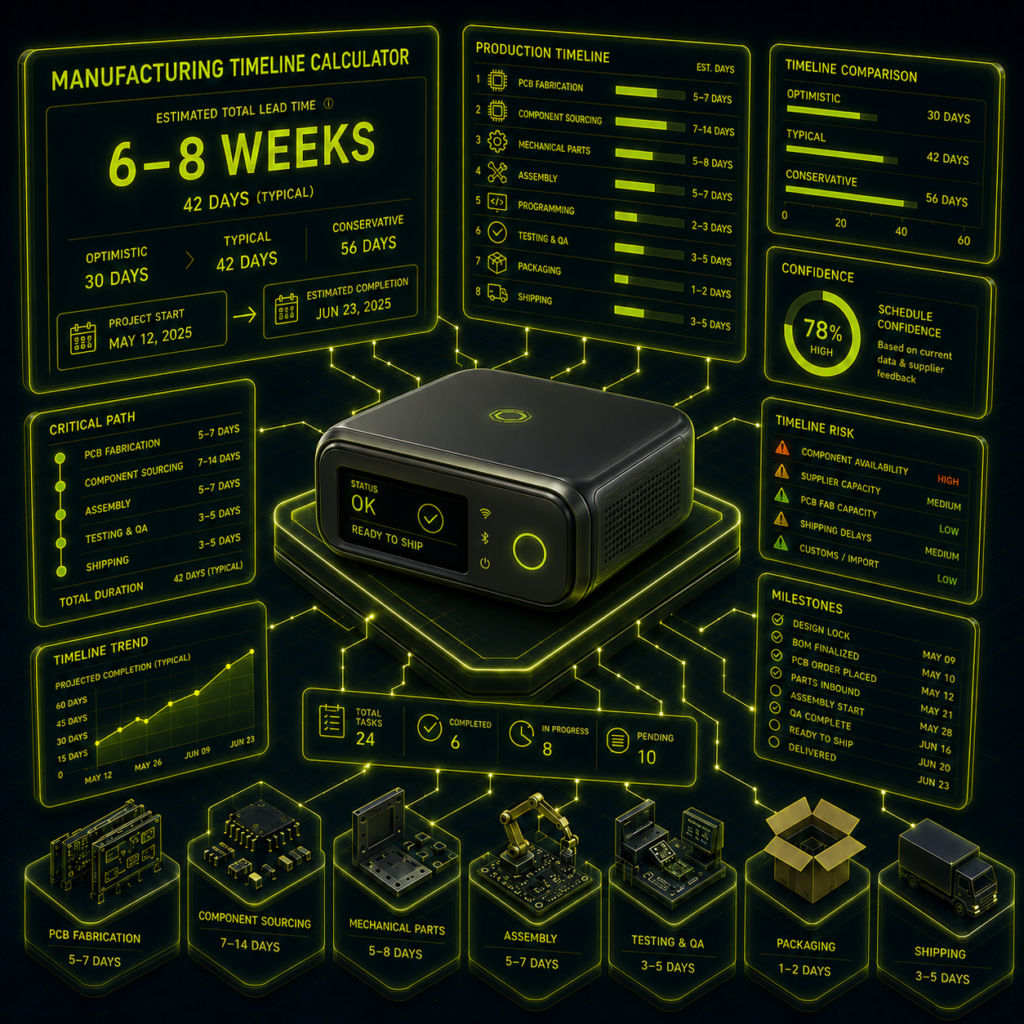
The calculator considers PCB fabrication, component sourcing, mechanical parts, assembly, programming, testing, packaging, logistics, and schedule risk to provide an estimated manufacturing timeline.
Note: This calculator is intended for planning and budgeting. It does not provide a guaranteed supplier or factory delivery date.
What Is a Manufacturing Timeline Calculator?
A Manufacturing Timeline Calculator helps estimate how long it may take to move a hardware product through the manufacturing process.
It is intended for projects where the core product design is already substantially complete and the product is ready to move toward fabrication and production.
The calculator focuses on activities such as:
- Manufacturing review
- PCB fabrication
- Component sourcing
- Mechanical fabrication
- PCB assembly
- Programming
- Product testing
- Final assembly
- Packaging
- Shipping
It does not estimate the complete product development timeline.
Activities such as product concept development, schematic design, PCB layout, firmware development, industrial design, and enclosure design should normally be completed before using this calculator.
How the Manufacturing Timeline Calculator Works
The calculator estimates how long it may take to manufacture an electronics or hardware product once the main design is ready for production.
It considers:
- PCB fabrication
- Component sourcing
- Mechanical parts
- PCB assembly
- Programming
- Testing
- Final assembly
- Packaging
- Shipping
- Schedule buffer
If you already know a supplier lead time, you can enter it manually for a more accurate estimate.
What Is a Manufacturing Timeline Calculator?
A Manufacturing Timeline Calculator helps estimate how long it may take to move a hardware product through the manufacturing process.
It is intended for projects where the core product design is already substantially complete and the product is ready to move toward fabrication and production.
The calculator focuses on activities such as:
- Manufacturing review
- PCB fabrication
- Component sourcing
- Mechanical fabrication
- PCB assembly
- Programming
- Product testing
- Final assembly
- Packaging
- Shipping
It does not estimate the complete product development timeline.
Activities such as product concept development, schematic design, PCB layout, firmware development, industrial design, and enclosure design should normally be completed before using this calculator.
Manufacturing Timeline Calculator
Estimate the manufacturing timeline for an electronics or hardware product from production release through sourcing, fabrication, assembly, testing, packaging and logistics.
Production Setup
Define the build stage, quantity and planned manufacturing start date.
Electronics
Set PCB complexity, component availability and PCB assembly requirements.
Mechanical Parts
Select the mechanical manufacturing route required for the product.
Production Operations
Add programming, testing, final assembly and packaging requirements.
Logistics & Risk
Add shipping time and a practical schedule contingency.
Manufacturing Timeline
Parallel supplier activities are modeled separately. The longest prerequisite controls when downstream production can begin.
Typical Critical-Path Breakdown
Only the longest parallel prerequisite delays the start of assembly.
Schedule Summary
Biggest Schedule Risks
How the timeline is calculated
PCB fabrication, component sourcing, mechanical parts and packaging preparation can usually proceed in parallel. The calculator waits for the longest required prerequisite, then adds PCB assembly, programming, testing, final assembly and packing in sequence. The selected schedule buffer is applied to the manufacturing path before logistics.
Use actual supplier lead times whenever available. They are more reliable than a general benchmark.
What Is Included?
This calculator focuses on the manufacturing stage, not the complete product-development process.
It includes activities from production preparation through final delivery, such as DFM review, sourcing, fabrication, assembly, testing, packaging, and logistics.
It does not normally include schematic design, PCB layout, firmware development, enclosure design, product prototyping, or certification.
How Is the Timeline Calculated?
Manufacturing activities do not always happen one after another.
For example, PCB fabrication, component sourcing, mechanical production, and packaging preparation can often happen in parallel.
The calculator identifies the longest required prerequisite, then adds the production stages that must happen afterward.
Example:
- PCB fabrication: 8 days
- Component sourcing: 14 days
- Mechanical parts: 10 days
The prerequisite phase is approximately 14 days, not 32 days, because these activities can run in parallel.
After that, assembly, programming, testing, final assembly, packing, and shipping are added.
Why Are Three Estimates Shown?
Manufacturing schedules contain uncertainty, so the calculator provides:
Optimistic — assumes minimal delays.
Typical — recommended for general project planning.
Conservative — allows more time for supplier, production, and coordination risks.
Using a range is more realistic than assuming one exact completion date.
Main Factors That Affect Manufacturing Time
Manufacturing time can increase because of:
- Higher PCB complexity
- Long-lead components
- Custom mechanical parts
- Large production quantities
- Complex PCB assembly
- Programming or calibration
- Functional or burn-in testing
- Custom packaging
- International shipping
- Supplier capacity or production delays
How to Reduce Manufacturing Lead Time
Where practical:
- Order long-lead components early.
- Start PCB fabrication and component sourcing in parallel.
- Begin mechanical production at the same time.
- Use standard PCB materials and processes.
- Prepare programming and test fixtures before assembly.
- Finalize packaging before production is complete.
- Confirm manufacturing capacity in advance.
- Use supplier-confirmed lead times whenever available.
The biggest schedule improvement usually comes from reducing delays on the critical path.
FAQ's
Does the calculator include product design?
No. It assumes the product design is substantially complete and ready for manufacturing.
Can I enter my supplier's actual lead time?
Yes. If your PCB, component, mechanical, or logistics supplier has provided a lead time, use that value instead of the general estimate.
Are PCB fabrication and component sourcing added together?
Not always. They can usually run in parallel, so the calculator considers the longest prerequisite instead of simply adding every stage.
Does production quantity affect the result?
Yes. Higher quantities can increase assembly, testing, final assembly, and packing time, although production time does not increase directly in proportion to quantity.
Does the calculator include shipping?
Yes. You can select a shipping method, enter your own shipping time, or exclude logistics completely.
Are weekends included?
No. Estimated completion dates are based on working days and exclude Saturdays and Sundays.
Is the result a guaranteed manufacturing schedule?
No. It is a planning estimate. Actual schedules depend on supplier capacity, component availability, yield, rework, holidays, customs, logistics, and other project-specific conditions.