How Machine Learning Improves Remote IoT Device Platforms and Fleet Management
Managing ten connected devices is usually straightforward.
A small team can check individual dashboards, respond to alerts, update firmware manually, and investigate unusual behaviour device by device.
Managing ten thousand devices is a very different problem.
At that scale, support teams cannot inspect every device individually. Static alarm thresholds begin producing too many notifications. Minor connectivity issues become difficult to separate from serious faults. Firmware problems may affect only a specific device group, while battery performance can vary widely depending on location, signal strength, and usage.
A traditional remote IoT device platform provides the tools needed to monitor, configure, update, and control connected devices. Machine learning adds another layer: it helps the platform recognise patterns across the fleet and identify which changes actually require attention.
This does not mean every device decision should be handed over to an algorithm. The real value of machine learning is helping teams make sense of device data faster, reduce unnecessary investigation, and focus on the parts of the fleet most likely to develop problems.
This article explains how machine learning improves IoT fleet management, where it delivers the greatest value, and what businesses should consider before adding intelligent analytics to an IoT remote management solution.
Why Basic Remote Monitoring Becomes Difficult at Scale
Most IoT platforms begin with a familiar set of capabilities:
- Device registration
- Connectivity monitoring
- Remote configuration
- Sensor-data collection
- Alarm notifications
- Firmware updates
- User and access management
- Device grouping
- Historical reporting
These functions remain essential as the fleet grows. However, the volume of information increases much faster than the number of people available to review it.
A fleet of several thousand devices may generate millions of readings, events, status changes, and diagnostic messages every day. Many of those events are normal. Some are temporary. A small number indicate a genuine problem.
The challenge is not simply collecting the data. It is deciding what the data means.
For example, a device that briefly disconnects once a week may be operating normally in an area with weak cellular coverage. Another device that reconnects twenty times each day may be approaching a serious hardware or network problem.
A simple platform may treat both devices in the same way because they crossed the same threshold. Machine learning can consider their wider behaviour and help distinguish a normal variation from a developing fault.
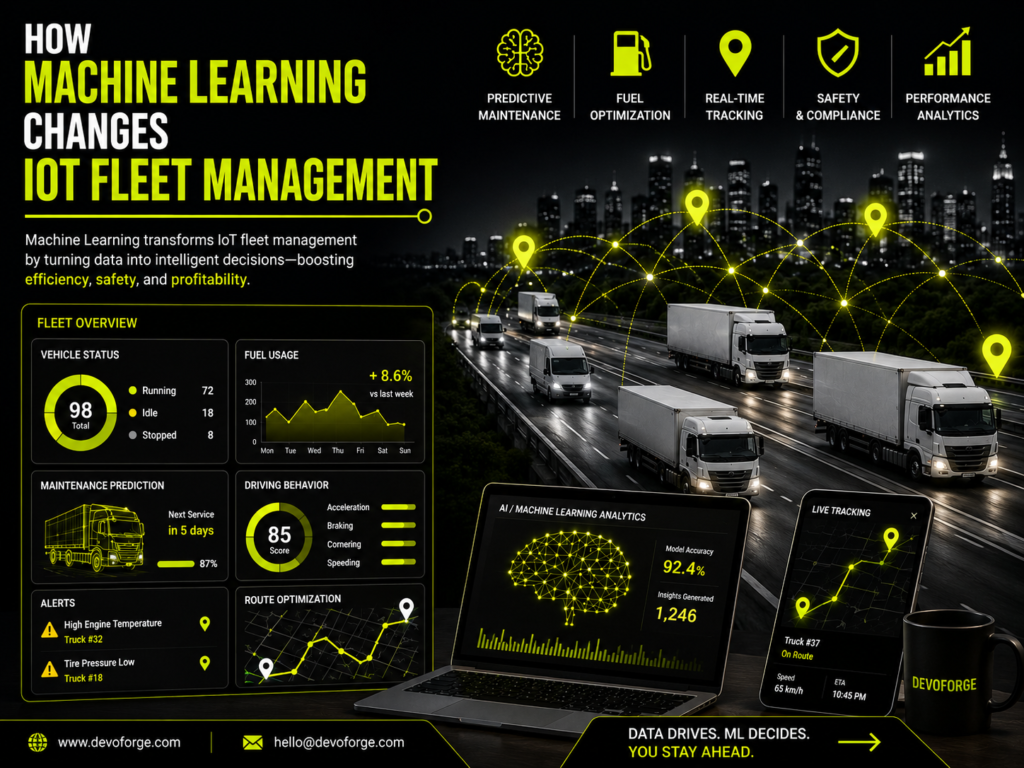
How Machine Learning Changes IoT Fleet Management
Machine learning models analyse historical and live device data to identify patterns, relationships, and unusual behaviour.
Within a remote IoT device platform, this capability can support several practical tasks.
It can help the system:
- Learn normal behaviour for different device types
- Detect unusual sensor or connectivity patterns
- Predict battery replacement requirements
- Identify devices at greater risk of failure
- Reduce false or repetitive alerts
- Group similar devices automatically
- Compare firmware performance across the fleet
- Forecast network and cloud usage
- Prioritise support cases
- Recommend the next diagnostic action
The platform moves from simply reporting what happened to helping users decide what deserves attention.
A standard dashboard might say:
Device 1042 disconnected five times today.
An ML-enabled platform may provide more useful context:
Device 1042 is disconnecting four times more frequently than similar devices in the same region, and the issue began after the latest firmware update.
The second message gives the support team a clearer starting point.
Learning What Normal Device Behaviour Looks Like
One of the most useful machine learning applications in IoT fleet management is behavioural baselining.
A fixed threshold assumes that all devices should behave in roughly the same way. In practice, normal behaviour may vary based on:
- Device model
- Firmware version
- Customer usage
- Installation location
- Network type
- Local temperature
- Power source
- Sensor configuration
- Time of day
- Product age
A battery-powered environmental sensor in a cold outdoor location will behave differently from the same model installed inside a warehouse. A device using cellular connectivity may have a different communication pattern from one using Wi-Fi or LoRaWAN.
Machine learning can establish separate baselines for different devices or groups.
Instead of asking whether a reading is above a universal limit, the platform can ask whether the reading is unusual for that specific device under its current operating conditions.
This approach is especially useful for detecting gradual changes that remain within traditional alarm limits.
Detecting Device Anomalies Earlier
Anomaly detection identifies behaviour that differs from an established pattern.
In a remote IoT fleet, anomalies may include:
- Unexpected sensor spikes
- Increasing restart frequency
- Unusual battery drain
- Repeated connection failures
- Abnormal data-transmission volume
- Missing readings
- Changes in response time
- Memory or processor usage increases
- Unexpected configuration changes
- Sensor drift
Not every anomaly represents a fault. A device may behave differently because the customer changed how it is used or because environmental conditions changed.
The purpose of anomaly detection is not to make an immediate final diagnosis. It is to identify behaviour that deserves closer review.
The system can also compare the device with similar units. If one hundred devices received the same firmware update and only three began restarting frequently, those three devices become a clear investigation priority.
Reducing Alert Fatigue
Alert fatigue is a common problem in large IoT deployments.
When teams receive too many low-value notifications, they may begin ignoring them. Important warnings can then become buried among repetitive battery, connectivity, and sensor alerts.
An intelligent IoT remote management solution can improve alert quality by considering context before sending a notification.
For example, it may evaluate:
- How far the reading is from normal
- How long the condition has continued
- Whether similar events occurred recently
- Whether other measurements changed at the same time
- How critical the device is
- Whether the problem affects one device or an entire group
- Whether the condition resolved itself
- What action was taken after previous alerts
The platform may then group related events into one incident rather than sending twenty separate notifications.
It can also assign a severity score. A short disconnection from a non-critical device may receive a low priority, while abnormal temperature and battery behaviour occurring together may be escalated immediately.
Reducing the number of alerts is not the main goal. The goal is making each alert more useful.
Creating Device Health Scores
A device health score gives support and operations teams a simple way to understand overall condition.
The score may combine information such as:
- Connectivity stability
- Battery condition
- Sensor accuracy
- Error frequency
- Restart history
- Firmware status
- Response time
- Data quality
- Environmental conditions
- Previous service events
The platform can use this score to sort the fleet and highlight devices that are gradually becoming less reliable.
Health scores are particularly useful when devices do not have one clear failure signal.
A device may still be online, but its battery is declining faster than expected, its signal quality is deteriorating, and its restart frequency has increased. Each issue may appear minor independently. Together, they indicate that the device should be inspected.
The scoring method should remain understandable. Users need to know which factors reduced the score and what action is recommended.
Predicting Battery Life More Accurately
Battery replacement can become one of the largest operating costs in remote IoT deployments.
A simple battery percentage does not always provide a reliable estimate of remaining life. Battery discharge is affected by:
- Transmission frequency
- Signal strength
- Sleep-cycle configuration
- Sensor activity
- Environmental temperature
- Device age
- Firmware behaviour
- Network reconnection attempts
- Battery chemistry
Two devices showing the same battery level may have very different remaining service lives.
Machine learning can analyse historical discharge patterns and operating conditions to estimate when a battery is likely to require replacement.
This allows businesses to:
- Schedule replacements before failure
- Combine service visits in the same area
- Reduce unnecessary early replacements
- Identify devices with abnormal power consumption
- Compare battery performance across firmware versions
- Improve future hardware and firmware design
For remote or difficult-to-access installations, more accurate battery forecasting can provide significant operational value.
Predicting Connectivity Problems
Connectivity is one of the most common sources of IoT support issues.
Devices may experience:
- Weak signal strength
- Network congestion
- SIM or carrier problems
- Gateway outages
- Packet loss
- Repeated reconnection
- DNS failures
- Incorrect network settings
- Environmental interference
A conventional platform can report when a device goes offline. Machine learning can help identify the patterns that often appear before that happens.
For example, the system may detect a gradual decline in signal quality, longer connection times, and increasing packet retries.
The device is still online, but its behaviour suggests that a loss of communication is becoming more likely.
This gives the support team time to investigate the installation, network provider, antenna position, or firmware settings before the device becomes unreachable.
Fleet-wide analysis can also reveal whether connectivity issues are associated with a particular region, carrier, hardware revision, or firmware release.
Making Firmware Updates Safer
Remote firmware updates are essential for maintaining connected products.
They allow businesses to fix bugs, add features, improve security, and change device behaviour without sending technicians to every installation.
However, a problem in an update can affect hundreds or thousands of devices.
Machine learning can support safer update management by helping teams:
- Select representative pilot devices
- Identify devices with higher update risk
- Compare behaviour before and after deployment
- Detect unusual restart or battery patterns
- Identify performance differences by hardware version
- Pause a rollout when abnormal behaviour appears
- Recommend rollback for affected device groups
A platform may first release an update to a small group containing different regions, network types, and hardware revisions.
The system then compares the group’s behaviour with its previous baseline. If connectivity failures or battery consumption increase significantly, the wider deployment can be paused.
This does not replace proper software testing. It adds another safeguard during real-world rollout.
Segmenting Large Device Fleets
Device grouping is usually handled manually through customer, location, model, or firmware labels.
Machine learning can find additional groups based on actual behaviour.
Devices may be clustered according to:
- Usage frequency
- Sensor patterns
- Power consumption
- Connectivity quality
- Environmental conditions
- Failure history
- Customer behaviour
- Data-transmission volume
These groups can reveal patterns that are not visible through standard labels.
For example, a fleet operator may discover that devices installed in warm locations and transmitting every five minutes have much shorter battery life than similar devices using a fifteen-minute interval.
The business can then adjust configuration, maintenance planning, or product design for that group.
Behaviour-based segmentation can also improve testing. Firmware changes can be evaluated against different usage profiles rather than only against device models.
Improving Remote Diagnostics
Support teams often spend significant time collecting basic information before they can begin solving a device problem.
They may need to check:
- Current firmware
- Last successful connection
- Battery level
- Recent errors
- Sensor activity
- Configuration changes
- Network quality
- Previous incidents
Machine learning can bring this information together and suggest likely causes.
For example:
The device’s high battery usage is most likely related to repeated cellular reconnection attempts rather than sensor activity.
This type of recommendation can help the team choose the next diagnostic step.
The platform may also identify similar historical incidents and show which actions resolved them.
The final decision should remain with the support or engineering team, especially when the problem is unfamiliar. The model should shorten investigation, not hide the evidence behind its recommendation.
Prioritising Support Cases
Not every device problem has the same business impact.
A temporary failure in a demonstration unit may be less urgent than abnormal behaviour in a device controlling a critical customer process.
An ML-enabled remote IoT device platform can help prioritise cases using:
- Device importance
- Customer service level
- Failure probability
- Number of affected devices
- Duration of the problem
- Previous incident history
- Potential safety or operational impact
- Availability of fallback systems
This allows teams to spend their time where it matters most.
A well-designed system should also explain why a case received a particular priority. Support staff need to be able to override the recommendation when they have additional information.
Forecasting Fleet Usage and Infrastructure Demand
Machine learning can also help manage the systems behind the devices.
A growing IoT fleet creates demand for:
- Cloud storage
- Data processing
- API traffic
- Message queues
- Cellular usage
- Technical support
- Replacement parts
- Field-service capacity
Historical fleet data can be used to forecast future demand.
For example, the platform may predict:
- Expected monthly data volume
- Peak messaging periods
- Number of likely battery replacements
- Support-ticket volume
- Devices approaching storage limits
- Regions requiring additional service capacity
This helps the business plan infrastructure and operating costs more accurately.
Forecasting is particularly useful when device usage changes by season, customer type, or geographic region.
Supporting Automated Responses
Some machine learning outputs can trigger automated actions.
Examples include:
- Reducing transmission frequency when abnormal battery drain is detected
- Restarting a non-critical software service
- Requesting additional diagnostic data
- Moving a device into a different monitoring group
- Delaying a firmware update
- Changing alert sensitivity
- Switching to a backup communication method
Automated responses should be introduced carefully.
The system should define:
- Which actions can occur automatically
- Which actions require human approval
- Safe operating limits
- Rollback behaviour
- Audit logging
- What happens when the model is uncertain
Actions affecting safety, customer operations, or critical device functions should not depend on an unverified model prediction.
A gradual approach is usually best. The system may begin by recommending actions, then automate selected low-risk responses after the recommendations have been validated.
The Role of Edge Machine Learning
Not every decision needs to be made in the cloud.
Edge machine learning runs on or near the device, using an embedded processor, gateway, or industrial computer.
This can be useful when:
- A fast response is required
- Connectivity is unreliable
- Raw data is too large to transmit continuously
- Data must remain local
- Bandwidth costs are high
- Devices need to operate offline
For example, an edge device may analyse vibration data locally and send only anomalies or summary features to the remote platform.
This reduces data traffic and allows monitoring to continue during network interruptions.
Edge systems also have limitations. They may have restricted memory, processing power, storage, and energy. Models must be designed to fit the available hardware.
The Role of Cloud Machine Learning
Cloud-based analysis is useful when data from many devices needs to be combined.
It can support:
- Fleet-wide pattern detection
- Model training
- Long-term data storage
- Comparison between regions
- Centralised health scoring
- Large-scale forecasting
- Frequent model updates
Cloud platforms generally provide greater computing flexibility than individual devices.
However, cloud-based systems depend on reliable data collection and require careful management of:
- Security
- Access permissions
- Data privacy
- Connectivity
- Storage costs
- Processing costs
- Service availability
Many IoT systems use a hybrid approach. Immediate processing happens at the edge, while fleet-level learning and reporting happen in the cloud.
Data Requirements for Machine Learning in IoT
Machine learning quality depends on data quality.
An IoT platform may collect a large amount of information but still lack the context needed to build useful models.
A strong dataset may include:
- Device identifiers
- Hardware version
- Firmware version
- Installation date
- Location or environment
- Sensor readings
- Connectivity events
- Battery measurements
- Error logs
- Configuration history
- Support tickets
- Maintenance records
- Customer usage information
- Known failure events
Time alignment is especially important.
If events from devices, gateways, cloud services, and support systems use inconsistent timestamps, it becomes difficult to understand what happened first.
Data also needs consistent labels. The same fault should not be described in several unrelated ways across support and maintenance records.
ML consulting services often begin with a data-readiness assessment because model development should not start until the available data has been understood.
When Machine Learning May Not Be Necessary
Machine learning should not be added simply to make a platform appear more advanced.
A conventional rule may be more suitable when:
- The required behaviour is clearly defined
- A fixed threshold provides reliable detection
- Very little historical data exists
- The fleet is small
- Device usage rarely changes
- Decisions must be completely deterministic
- The cost of a wrong prediction is too high
- The problem can be solved through better firmware or hardware
For example, a device should not use machine learning to decide whether a safety limit has been exceeded. A tested rule or safety control is more appropriate.
Machine learning adds value when the problem involves complex patterns, changing behaviour, or large amounts of fleet data that cannot be reviewed manually.
A Practical Implementation Roadmap
Businesses do not need to make every part of an IoT platform intelligent at once.
A focused implementation may follow these stages.
1. Define the Operational Problem
Start with a specific challenge, such as excessive false alerts, unexpected battery failures, or repeated connectivity incidents.
2. Select a Measurable Use Case
Choose a problem where improvement can be measured through alert reduction, lower support time, fewer outages, or longer battery life.
3. Review Available Data
Determine whether the platform collects the signals, metadata, and historical outcomes required.
4. Establish a Baseline
Measure current fleet performance before introducing the model.
5. Build a Proof of Concept
Test the approach on a limited device group.
6. Validate with Real Users
Support, engineering, and operations teams should review the model’s outputs and recommendations.
7. Integrate into the Existing Workflow
The model should improve the existing dashboard, alerts, or support system rather than creating an isolated analytics tool.
8. Deploy Gradually
Expand to additional devices after performance has been confirmed.
9. Monitor Model Quality
Track false alerts, missed problems, user overrides, and changes in device behaviour.
10. Retrain When Necessary
Update the model when firmware, hardware, usage, or operating environments change significantly.
Common Mistakes to Avoid
Starting Without a Clear Business Problem
“Add machine learning” is not a project objective. The system should address a defined operational issue.
Treating All Devices as Identical
Normal behaviour may vary significantly by device type, location, firmware, and customer usage.
Ignoring Metadata
Sensor readings are more useful when combined with firmware, hardware, configuration, and environmental information.
Automating Decisions Too Early
Models should normally begin by supporting human decisions before they are allowed to trigger actions automatically.
Measuring Only Model Accuracy
Operational value may be better measured through fewer alerts, reduced support time, improved uptime, or better battery planning.
Creating an Isolated ML Dashboard
Insights should appear inside the systems that support and operations teams already use.
Forgetting Model Maintenance
Device behaviour changes over time. Models need monitoring, review, and occasional retraining.
Using Machine Learning Where a Simple Rule Is Better
A clear, reliable rule is often easier to explain, test, and maintain.
How ML Consulting Services Support IoT Projects
Building machine learning into an IoT platform requires more than data-science expertise.
The project may involve:
- Embedded firmware
- Device communication
- Cloud infrastructure
- Data pipelines
- Time-series analysis
- Model development
- Dashboard integration
- Cybersecurity
- Fleet operations
- Support workflows
ML consulting services help connect these areas and determine whether the proposed use case is technically and commercially practical.
A consulting engagement may include:
- Use-case identification
- IoT data-readiness assessment
- Device and platform architecture review
- Data cleaning and preparation
- Feature engineering
- Model selection
- Proof-of-concept development
- Edge-versus-cloud analysis
- Platform integration
- Performance validation
- Model monitoring strategy
The objective should be a useful fleet-management capability, not simply a model with a high laboratory accuracy score.
How DevoForge Builds Intelligent IoT Management Solutions
At DevoForge, we develop connected systems across the device, firmware, cloud, and machine learning layers.
Our work can support projects involving:
- Custom remote IoT device platforms
- Device provisioning and fleet management
- Embedded firmware integration
- Remote monitoring dashboards
- Connectivity diagnostics
- Device health scoring
- IoT anomaly detection
- Battery-life forecasting
- Intelligent alert prioritisation
- ML-assisted firmware monitoring
- Edge machine learning
- Cloud analytics
- API and business-system integration
- Proof-of-concept development
- Production deployment and ongoing support
We begin by understanding the fleet, the device data, and the operational problem.
In some projects, machine learning may be the right solution. In others, better firmware, clearer device states, or improved rule-based alerts may deliver greater value.
The aim is to build an IoT remote management solution that helps teams manage devices more effectively rather than simply presenting more data.
Frequently Asked Questions
What is a remote IoT device platform?
A remote IoT device platform is a software system used to register, monitor, configure, update, and manage connected devices from a central location.
How does machine learning improve IoT fleet management?
Machine learning can identify unusual behaviour, predict battery or connectivity problems, reduce false alerts, score device health, and prioritise support cases.
Does every IoT platform need machine learning?
No. Smaller or predictable fleets may be managed effectively with conventional rules and dashboards. Machine learning becomes more valuable as device behaviour and fleet data become more complex.
What data is required for machine learning?
Useful data may include sensor readings, connectivity logs, battery history, firmware versions, hardware information, configuration changes, support cases, and known failure events.
Can machine learning run directly on an IoT device?
Yes. Edge machine learning can run on embedded devices or gateways when the hardware has sufficient processing power and memory.
Is cloud machine learning better than edge machine learning?
Neither approach is universally better. Edge processing offers fast local response and reduced connectivity dependence, while cloud analysis is useful for fleet-wide insights and model training.
Can machine learning reduce IoT device alerts?
Yes. It can combine related events, learn device-specific baselines, assign severity, and filter short-lived conditions that do not require action.
How can machine learning support firmware updates?
It can help select pilot groups, detect unusual post-update behaviour, identify high-risk devices, and support rollout or rollback decisions.
Can older IoT products use machine learning?
Yes, provided useful device data can be collected and transferred to an edge or cloud platform. Firmware or gateway changes may be required.
What is the first step in adding ML to an IoT platform?
Begin with a specific operational problem and assess whether the available device data is sufficient to address it.
Final Thoughts
A remote IoT device platform gives businesses visibility and control over connected products. Machine learning helps that platform decide where attention is needed most.
The greatest benefits usually come from practical applications: identifying unusual behaviour, reducing alert noise, predicting battery or connectivity problems, and helping support teams prioritise the right devices.
Successful implementation begins with a clearly defined problem and reliable fleet data. It also requires close coordination between embedded engineering, cloud development, data science, and device operations.
Machine learning should not replace every rule or human decision. It should make a large and complex device fleet easier to understand, support, and improve.
Looking to add intelligent monitoring to your connected-device platform?
Speak with the DevoForge engineering team about your device fleet, current platform, available data, and machine learning opportunities.
CTA Button: Discuss Your Intelligent IoT Platform