The Internet of Things (IoT) is transforming how businesses design products, collect data, and automate operations. From smart industrial equipment and connected medical devices to AI-enabled consumer electronics, IoT is no longer experimental—it’s a core business capability.
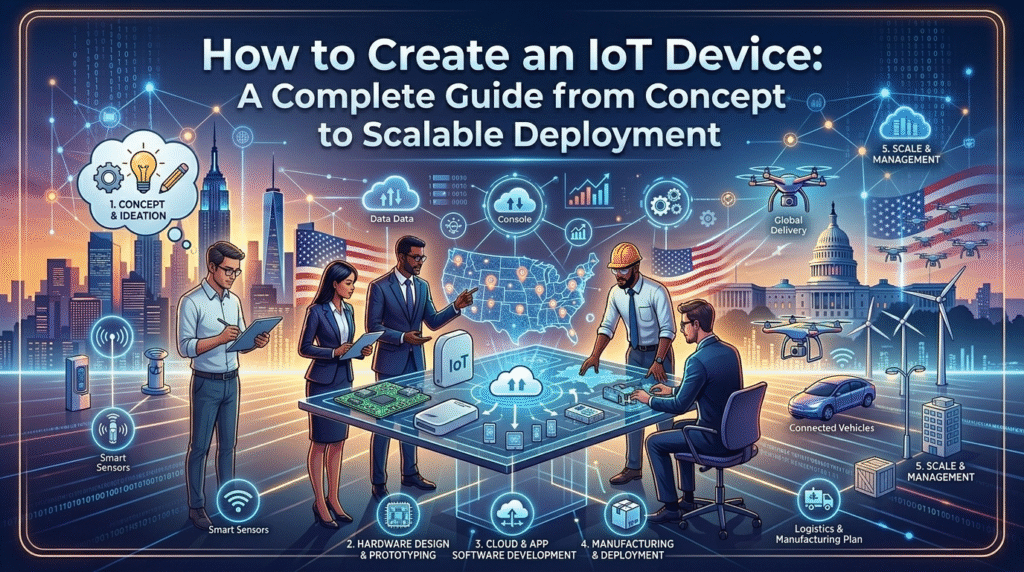
In this guide, we’ll walk you through how to create an IoT device step-by-step, covering everything from product research and concept design to cloud integration, AI automation, and manufacturing support. This guide is written for startups, enterprises, and mid-market companies looking to partner with a custom IoT development company like DevoForge.
What Is an IoT Device?
An IoT device is a physical product embedded with sensors, processors, connectivity, and software that allows it to collect data, communicate over the internet, and perform intelligent actions.
Examples of IoT Devices Across Industries
Some common examples of IoT devices include:
- Smart energy meters and grid monitoring systems
- Industrial condition monitoring sensors
- Smart medical wearables and diagnostics devices
- Fleet tracking and telematics systems
- Smart home devices (thermostats, security cameras)
- AI-enabled automation controllers for factories
Each of these products follows a structured IoT development lifecycle, which we’ll break down next.
Step 1: Product Research & Concept Design
Every successful IoT product starts with clear problem definition.
Key Questions to Answer:
- What business problem does the IoT device solve?
- Who are the end users?
- What data needs to be collected and why?
- Should AI or automation be embedded from day one?
At DevoForge, we conduct product research and concept design to align technical feasibility with business goals. This phase includes:
- Market validation
- Use-case mapping
- Feature prioritization
- Regulatory and compliance considerations
This is where many IoT projects fail if rushed—solid foundations save massive costs later.
Step 2: Engineering & System Architecture
Once the concept is validated, the next step is engineering the system architecture.
Core Components of an IoT Architecture:
- Hardware Layer – Sensors, microcontrollers, power systems
- Firmware Layer – Device logic, communication protocols
- Connectivity Layer – Wi-Fi, LTE, NB-IoT, LoRaWAN, Ethernet
- Cloud & Backend Layer – Data storage, APIs, dashboards
- Application Layer – Web and mobile apps
As one of the experienced IoT app development companies, DevoForge ensures that all layers are designed for scalability, security, and long-term maintainability.
Step 3: Hardware Selection & Firmware Development
Choosing the right hardware platform is critical.
Hardware Selection Considerations:
- Processing requirements
- Power consumption
- Environmental conditions
- Cost at scale
Firmware development includes:
- Sensor data acquisition
- Secure device bootloaders
- OTA (Over-The-Air) updates
- Communication protocol implementation (MQTT, HTTP, CoAP)
This stage bridges DevoForge’s deep embedded expertise (backed by years of work via arduinoexpert.com) with enterprise-grade product engineering.
Step 4: Prototyping, Testing & Validation
Before mass production, every IoT product must go through rigorous prototyping and validation.
What Happens in This Phase:
- Functional prototypes (EVT, DVT stages)
- Hardware stress testing
- Connectivity and latency testing
- Security validation
- Field trials with real users
This step ensures the device performs reliably in real-world environments—not just lab conditions.
Step 5: IoT & Cloud Integration
An IoT device is only as powerful as its backend.
Cloud Capabilities Include:
- Device provisioning and authentication
- Real-time data ingestion
- Rule engines and alerts
- Analytics dashboards
- API integrations with ERP, CRM, or MES systems
Many clients ask about the best remote IoT device management platform or the best remote IoT device management software. The answer depends on:
- Scale of deployment
- Security requirements
- Customization needs
DevoForge builds custom or hybrid device management platforms, ensuring flexibility without vendor lock-in.
Step 6: AI & Automation Integration
Modern IoT products go beyond monitoring—they think and act.
AI & Automation Use Cases:
- Predictive maintenance
- Anomaly detection
- Automated decision workflows
- Demand forecasting
- Intelligent alerts and control systems
We specialize in AI and automation deployment for mid-market companies, enabling them to leverage machine learning without enterprise-level complexity or cost.
Step 7: Manufacturing Support & Supply Chain Readiness
Moving from prototype to production is a major leap.
Manufacturing Support Includes:
- BOM optimization
- DFM / DFA reviews
- Supplier coordination
- Test jigs and production firmware
- Quality assurance workflows
DevoForge supports clients throughout the manufacturing and supply chain lifecycle, ensuring smooth scale-up and cost efficiency.
Why Partner with a Custom IoT Development Company?
Building an IoT device requires multidisciplinary expertise—hardware, software, cloud, AI, and manufacturing.
A custom IoT development company like DevoForge provides:
- End-to-end product ownership
- Faster time-to-market
- Reduced technical risk
- Long-term scalability
We complement our product engineering DNA with execution experience gained through hundreds of embedded and IoT projects via arduinoexpert.com.
Final Thoughts: Turning IoT Ideas into Scalable Products
Creating an IoT device is not just about electronics—it’s about building a connected, intelligent, and scalable product ecosystem.
From concept design and system architecture to AI-driven automation and manufacturing support, DevoForge helps companies turn ideas into market-ready IoT products.
If you’re evaluating IoT app development companies or planning your next connected product, now is the right time to build it the right way.