Most industrial equipment does not fail without warning.
A bearing may begin vibrating differently. A motor may draw slightly more current. A pump may take longer to reach its normal pressure. A gearbox may gradually run hotter than it did a few weeks earlier.
These changes are often small at first. They may not trigger a conventional alarm, and they may be difficult for an operator to notice during a busy production shift. By the time the warning becomes obvious, the machine may already be close to failure.
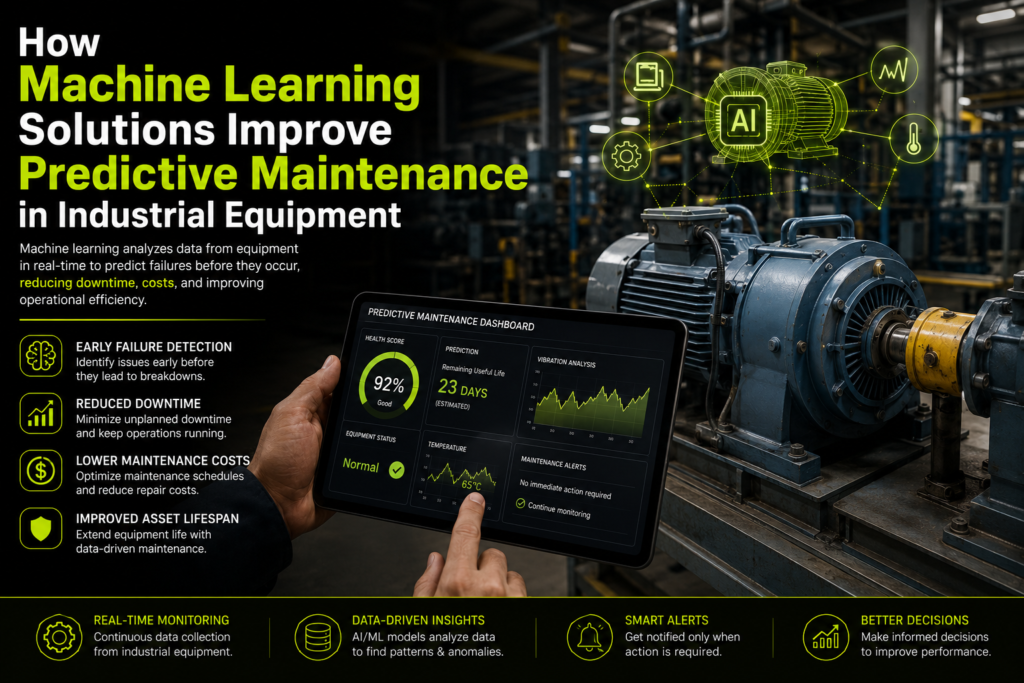
Predictive maintenance aims to identify these early changes before they cause a serious breakdown. Instead of waiting for equipment to stop or replacing parts according to a fixed calendar, maintenance teams use real operating data to decide when attention is required.
Machine learning solutions can make this process more effective by analysing large amounts of equipment data, identifying patterns and detecting behaviour that differs from normal operation.
However, predictive maintenance is not simply a matter of installing sensors and training an algorithm. The value comes from selecting the right equipment, collecting reliable data and turning model outputs into practical maintenance actions.
This article explains how machine learning supports predictive maintenance, what data is required and how industrial businesses can introduce it without creating an unnecessarily complicated system.
The Difference Between Reactive, Preventive and Predictive Maintenance
Before looking at machine learning, it is helpful to understand the main maintenance approaches.
Reactive Maintenance
Reactive maintenance means repairing equipment after it fails.
This approach may be acceptable for inexpensive or non-critical assets that can be replaced quickly. It becomes costly when a failure stops production, damages other components or creates a safety risk.
Reactive maintenance can lead to:
- Unplanned downtime
- Emergency repair costs
- Overtime
- Delayed orders
- Product loss
- Secondary equipment damage
- Difficulty obtaining spare parts at short notice
Preventive Maintenance
Preventive maintenance is performed according to a planned schedule.
A bearing might be replaced every six months, for example, even if it is still functioning normally. This reduces the risk of unexpected failure but can also lead to unnecessary maintenance.
The schedule may be based on:
- Calendar time
- Operating hours
- Production cycles
- Manufacturer recommendations
- Previous maintenance experience
Preventive maintenance is predictable, but it does not always reflect the actual condition of the equipment.
Two identical motors may operate under very different loads. Replacing both at the same interval may mean changing one too early and servicing the other too late.
Predictive Maintenance
Predictive maintenance uses equipment-condition data to determine when maintenance is likely to be needed.
Instead of asking, “How long has this machine been running?” the maintenance team asks:
- Is its behaviour changing?
- Is the change normal for the current operating condition?
- Is performance moving towards a known failure pattern?
- How urgently should the equipment be inspected?
Machine learning solutions can support these decisions by analysing relationships that are difficult to monitor using fixed thresholds alone.
Why Traditional Maintenance Alerts Are Often Limited
Many industrial machines already use alarms.
A motor may stop when its temperature exceeds a set limit. A pump may trigger an alert when pressure falls below a fixed value. A conveyor may shut down when excessive current indicates a jam.
These rules are important for protecting equipment, but they usually respond after a value has already crossed an unsafe limit.
They may not detect gradual deterioration.
For example, a motor might normally operate at 60°C. Over several weeks, its temperature may rise slowly to 72°C. If the alarm threshold is 85°C, the machine will continue operating without warning, even though the trend may suggest increasing friction, poor cooling or bearing wear.
Fixed thresholds also struggle when normal behaviour changes with production conditions.
A machine may use more power when processing a heavier product. Its vibration level may change at different speeds. Its temperature may increase during a long production run and return to normal during a break.
A simple rule cannot always separate a genuine problem from normal operational variation.
Machine learning can analyse several variables together and compare current behaviour with historical patterns under similar conditions.
How Machine Learning Supports Predictive Maintenance
Machine learning models learn patterns from historical or live data.
In predictive maintenance, these patterns can help identify normal operation, abnormal behaviour and conditions that have previously appeared before a failure.
Machine learning solutions can support maintenance teams in several ways.
Detecting Subtle Changes
A model may identify small changes across vibration, temperature and current that would not trigger individual alarms.
Each change might appear harmless on its own. Together, they may indicate that the machine is beginning to operate differently.
Identifying Anomalies
Anomaly detection models learn what normal equipment behaviour looks like and flag observations that fall outside that pattern.
This is useful when there are few examples of actual machine failures, which is common in industrial environments.
Estimating Failure Risk
Where sufficient historical failure data exists, a model may estimate the likelihood that a component will fail within a particular period.
The output should normally be treated as a risk indicator rather than a guaranteed prediction.
Estimating Remaining Useful Life
Some systems attempt to estimate how much useful operating time remains before maintenance or replacement is required.
This can help teams plan work during a scheduled shutdown rather than responding to an emergency.
Prioritising Maintenance Work
Machine learning can help maintenance teams focus on the equipment showing the strongest signs of deterioration.
This is especially useful in facilities with hundreds or thousands of assets.
Reducing False Alarms
A model can consider operating speed, load, product type and environmental conditions before deciding whether a reading is unusual.
This may reduce alerts caused by normal production changes.
What Equipment Data Can Be Used?
The success of predictive maintenance depends heavily on the quality and relevance of the data.
Different machines require different signals. There is no universal sensor package that works for every asset.
Common data sources include the following.
Vibration Data
Vibration monitoring is widely used for rotating equipment such as:
- Motors
- Pumps
- Fans
- Compressors
- Gearboxes
- Spindles
- Bearings
Changes in vibration may indicate:
- Misalignment
- Imbalance
- Looseness
- Bearing damage
- Gear wear
- Structural problems
The usefulness of vibration data depends on sensor placement, sampling rate and understanding how the machine behaves at different speeds and loads.
A poorly placed sensor may record surrounding machine movement rather than the condition of the component being monitored.
Temperature Data
Temperature is useful for monitoring:
- Motors
- Bearings
- Hydraulic systems
- Gearboxes
- Electrical panels
- Ovens
- Process fluids
- Cooling systems
A rising temperature trend may indicate friction, overloading, restricted airflow or poor lubrication.
However, temperature should be interpreted in context. Ambient conditions, production load and machine warm-up can all affect readings.
Electrical Current and Power
Motor current and power consumption can reveal changes in equipment load.
Unusual electrical behaviour may indicate:
- Mechanical resistance
- Conveyor jams
- Pump restrictions
- Tool wear
- Motor problems
- Incorrect machine settings
- Changes in product or material
Electrical data can sometimes be collected without modifying the machine mechanically, making it useful for retrofitting older equipment.
Pressure and Flow
Pressure and flow data are valuable for:
- Pumps
- Compressors
- Pneumatic systems
- Hydraulic equipment
- Fluid-processing systems
- Filtration systems
Changes may indicate leaks, restrictions, worn components or blockages.
Acoustic and Ultrasonic Data
Sound can provide early information about leaks, bearing problems, friction and abnormal mechanical contact.
The challenge is separating machine-related sound from background factory noise.
Speed and Position
Encoders, proximity sensors and position feedback can reveal:
- Slower movements
- Incomplete travel
- Mechanical slippage
- Timing changes
- Irregular cycle behaviour
Production and Operational Data
Sensor readings become more meaningful when combined with operating context.
Useful information may include:
- Machine speed
- Product type
- Production recipe
- Load
- Shift
- Operator mode
- Cycle count
- Runtime
- Idle time
- Maintenance history
- Previous alarms
- Environmental conditions
A temperature of 75°C may be normal at full load but unusual when the machine is idle. Without operating context, the model may generate misleading results.
Maintenance and Failure Records
Historical maintenance information can help connect equipment behaviour with actual problems.
Useful records include:
- Failure dates
- Replaced components
- Inspection results
- Fault codes
- Work orders
- Repair notes
- Lubrication records
- Parts used
- Duration of downtime
Unfortunately, maintenance records are often written in different formats or contain incomplete descriptions.
One technician may record “bearing failure,” while another writes “motor noise” for the same type of problem. Cleaning and standardising this data is often one of the most important parts of the project.
Rule-Based Monitoring vs Machine Learning
Not every predictive maintenance problem requires machine learning.
A fixed rule may be entirely suitable when the relationship between a measurement and a fault is clear.
For example:
- Stop the machine if pressure falls below a safe level
- Raise an alert if temperature remains above 90°C for five minutes
- Notify maintenance after 2,000 operating hours
- Shut down a motor when current exceeds its protection limit
These rules are understandable, easy to test and relatively simple to maintain.
Machine learning becomes more useful when:
- Several variables interact
- Normal behaviour changes with operating conditions
- Failure patterns develop gradually
- Fixed thresholds generate too many false alerts
- Historical data contains useful patterns
- Equipment fleets are too large for manual analysis
- The same asset behaves differently under different loads
In many industrial systems, the best approach combines both methods.
Safety limits and critical machine protection remain rule-based, while machine learning provides additional condition insights and early warnings.
Machine learning should not replace safety-rated controls or established equipment-protection logic.
A Practical Predictive Maintenance Workflow
A machine learning project usually involves more than training a model.
The complete workflow may include several stages.
1. Select the Right Equipment
The first project should focus on an asset where failure has a meaningful impact.
Suitable candidates often include equipment that:
- Causes major production downtime
- Is expensive to repair
- Has a measurable deterioration pattern
- Produces useful operating data
- Fails frequently enough to study
- Has long spare-part lead times
- Creates quality or safety problems when performance declines
An inexpensive backup fan may not justify a complex predictive system. A critical compressor serving an entire production area may be a much stronger candidate.
2. Define the Maintenance Question
The objective should be specific.
Examples include:
- Detect abnormal bearing behaviour
- Identify pump cavitation
- Predict when a cutting tool needs replacement
- Detect increased motor load
- Identify declining compressor efficiency
- Estimate the risk of conveyor gearbox failure
“Use AI to improve maintenance” is too broad to guide model development.
The team should also decide what action will follow an alert.
If no one knows what to do when the system identifies abnormal behaviour, the model will add information without improving maintenance.
3. Establish a Baseline
Before predicting failures, the system needs to understand normal operation.
Data should be collected across:
- Different machine speeds
- Different product types
- Light and heavy loads
- Start-up and shutdown
- Normal production
- Cleaning
- Changeovers
- Seasonal or environmental variation
This baseline helps prevent the model from treating every operational change as a fault.
4. Clean and Prepare the Data
Industrial data is rarely ready for machine learning when it is first collected.
Common issues include:
- Missing readings
- Sensor noise
- Incorrect timestamps
- Duplicate records
- Communication interruptions
- Sensor calibration changes
- Different sampling rates
- Inconsistent maintenance labels
- Data collected during machine tests
- Unrecorded operating changes
Data preparation may involve filtering, aligning, resampling, labelling and combining information from different sources.
This stage can require more work than model training.
5. Create Useful Features
Raw data is not always the most useful input for a model.
Engineers may calculate features such as:
- Average temperature
- Rate of temperature increase
- Vibration frequency components
- Peak vibration
- Current variation
- Pressure stability
- Cycle-time deviation
- Energy consumed per production cycle
- Time since previous maintenance
- Number of starts and stops
The best features usually combine data science with equipment knowledge.
A data scientist may identify statistical patterns, while an engineer explains which patterns are physically meaningful.
6. Train and Compare Models
Several approaches may be tested.
Anomaly Detection
The model learns normal behaviour and identifies unusual observations.
This is useful when failure examples are limited.
Classification
The model assigns data to categories such as:
- Normal
- Warning
- Bearing fault
- Misalignment
- Overload
Classification requires reliable labelled examples.
Regression
The model predicts a numerical value, such as temperature, vibration level or remaining useful life.
Time-Series Forecasting
The system predicts how a measurement is likely to change over time.
Clustering
The model groups similar machine behaviours without requiring predefined labels.
The most complex model is not always the best choice. Industrial teams often benefit from models that are easier to understand, validate and maintain.
7. Validate with Real Equipment Behaviour
A model that performs well on historical data may still fail under real production conditions.
Validation should examine:
- False alarms
- Missed faults
- Performance under different loads
- New product types
- Sensor failures
- Communication interruptions
- Maintenance changes
- Equipment ageing
- Unusual but acceptable operating conditions
The model should be tested with maintenance technicians and equipment engineers, not evaluated only through statistical accuracy.
A model can appear accurate because normal operation represents most of the data. That does not necessarily mean it detects the rare failures the business cares about.
8. Integrate the Output into Maintenance Workflows
A prediction has little value if it remains inside a separate analytics dashboard that maintenance teams rarely open.
Alerts should connect with the way work is already managed.
The system may:
- Send an email or mobile notification
- Create a maintenance work order
- Display a warning on an HMI
- Update a plant dashboard
- Notify a control room
- Add the equipment to an inspection queue
The alert should explain:
- Which asset is affected
- What abnormal behaviour was detected
- When it began
- How severe it appears
- Which signals contributed to the warning
- What inspection is recommended
“Model score 0.86” is not a useful maintenance instruction.
“Drive-end bearing vibration has increased steadily for seven days” is much more actionable.
9. Monitor the Model After Deployment
Machine learning models can become less accurate as equipment, products and processes change.
This is sometimes referred to as model drift.
Changes may result from:
- New operating speeds
- Different materials
- Component replacement
- Sensor replacement
- Machine modification
- Environmental changes
- New production recipes
- Maintenance improvements
The model should therefore be monitored and periodically reviewed.
Predictive maintenance is an ongoing operational programme, not a one-time software installation.
Real-World Applications of Machine Learning in Maintenance
Rotating Equipment Monitoring
Motors, pumps and gearboxes generate vibration, temperature and electrical data.
Machine learning can identify combinations of changes that may indicate bearing wear, imbalance or alignment problems.
Tool-Wear Prediction
Manufacturing tools often wear gradually.
A model may analyse spindle current, vibration, sound, cycle time and product-quality data to estimate when a tool needs inspection or replacement.
This can reduce both unexpected breakage and premature tool changes.
Pump and Compressor Performance
A pump may continue running while becoming less efficient.
Pressure, flow, power and temperature data can help identify cavitation, leakage, restriction or wear before the equipment stops completely.
Conveyor Monitoring
Machine learning solutions can analyse motor current, speed, vibration and stoppage patterns to detect increasing resistance, belt problems, gearbox wear or recurring jams.
Industrial HVAC Systems
Fans, pumps, compressors and heat exchangers can be monitored for declining performance.
The system may detect abnormal energy use even before a component reaches a critical alarm threshold.
Electrical Equipment
Transformers, switchgear and industrial panels can be monitored using temperature, current, voltage and partial-discharge data where appropriate.
Production Quality and Equipment Condition
Equipment deterioration sometimes appears first in product quality.
A model may connect increasing defect rates with changing machine conditions, helping maintenance teams identify the source before the process produces a larger quantity of rejected material.
Edge Machine Learning vs Cloud-Based Analysis
Predictive maintenance data can be processed locally, in the cloud or through a hybrid architecture.
Edge Processing
Edge machine learning runs close to the equipment, using an industrial computer, gateway or embedded device.
Advantages may include:
- Fast response
- Reduced dependence on internet connectivity
- Lower bandwidth requirements
- Better control over sensitive production data
- Continued operation during network interruptions
Edge systems may have limited processing power and may require careful management of model updates.
Cloud Processing
Cloud platforms can combine data from multiple sites and provide scalable storage and computing.
Advantages may include:
- Centralised monitoring
- Easier fleet comparisons
- Flexible data storage
- More powerful model training
- Access across different locations
Cloud systems depend on reliable connectivity and require careful attention to cybersecurity, data access and ongoing service costs.
Hybrid Architecture
A hybrid system may perform immediate anomaly detection locally while sending selected data to a central platform for long-term analysis and model improvement.
The architecture should be selected based on operational requirements rather than assuming that every predictive maintenance system must be cloud-based.
Common Challenges in Predictive Maintenance Projects
Limited Failure Data
Industrial equipment is often designed to operate reliably, so there may be few recorded failures.
This is good operationally but difficult for supervised machine learning.
Anomaly detection, simulation, engineering rules and transfer learning may be considered when labelled failure examples are limited.
Poor Maintenance Records
Incomplete or inconsistent maintenance notes make it difficult to connect sensor behaviour with real failure events.
Improving record quality may be an important early project task.
Sensor Quality and Placement
A sophisticated model cannot compensate for poor measurements.
Incorrect placement, loose mounting, electrical noise and sensor drift can all reduce reliability.
Changing Operating Conditions
Normal machine behaviour may vary with speed, load, product and environment.
The system must account for these differences to avoid unnecessary alerts.
Too Many Alerts
If the system generates frequent low-value warnings, maintenance teams may stop trusting it.
Alert thresholds and model sensitivity should be adjusted using real operational feedback.
Lack of Explainability
Maintenance teams need to understand why an alert was generated.
A model that provides no supporting information may be difficult to trust, especially when maintenance requires production downtime.
No Clear Response Process
Predictive maintenance fails when alerts do not lead to inspections, work orders or decisions.
Technology must be connected to ownership and action.
Integration with Legacy Equipment
Older machines may not provide modern communication or structured data.
Additional sensors, embedded data-acquisition devices or industrial gateways may be required.
How to Measure the Value of Machine Learning Predictive Maintenance
The success of a predictive maintenance project should be measured using operational results, not only model accuracy.
Useful metrics may include:
- Reduction in unplanned downtime
- Number of failures detected early
- Reduction in emergency maintenance
- Maintenance cost per asset
- Spare-part usage
- Mean time between failures
- Mean time to repair
- Number of unnecessary inspections
- Reduction in product defects
- Equipment availability
- Maintenance schedule compliance
- False-alarm rate
The system should be compared with baseline performance collected before implementation.
Financial value may come from several areas.
A single avoided production stoppage may justify the project on a critical asset. In other cases, value may come gradually through better maintenance planning, reduced overtime and longer component life.
The business case should use realistic assumptions rather than assuming that every warning prevents a failure.
When Machine Learning May Not Be the Right Solution
Machine learning is not always necessary.
A simpler approach may be better when:
- The equipment is inexpensive and easy to replace
- Failure has little operational impact
- A clear threshold already identifies the problem
- Very little useful data is available
- The process changes constantly
- The asset will soon be replaced
- Maintenance teams cannot act on alerts
- Sensor installation would cost more than the expected benefit
A machine learning consulting assessment should be able to recommend against machine learning when a conventional monitoring or preventive-maintenance approach is more practical.
The goal should be to improve equipment reliability, not to force machine learning into every maintenance process.
How Machine Learning Consulting Services Help
Developing a predictive maintenance system requires several areas of expertise.
The team may need to understand:
- Industrial equipment
- Sensors and embedded systems
- Data engineering
- Machine learning
- Cloud or edge architecture
- Software integration
- Maintenance operations
- Cybersecurity
- User-interface design
Machine learning consulting services help connect these areas.
A consulting engagement may include:
- Identifying suitable equipment
- Defining the maintenance objective
- Reviewing available data
- Selecting sensors
- Designing data-collection architecture
- Assessing machine learning feasibility
- Building an initial proof of concept
- Comparing models
- Integrating alerts with existing systems
- Measuring operational value
- Planning model monitoring and retraining
The consulting stage helps determine whether the project has enough data and business value before a full system is developed.
How DevoForge Develops Predictive Maintenance Solutions
At DevoForge, we approach predictive maintenance as a complete engineering system rather than a standalone machine learning model.
Depending on the project, our work can include:
- Industrial equipment assessment
- Sensor selection and integration
- Embedded monitoring device development
- Machine data acquisition
- Industrial communication integration
- Edge and cloud architecture
- Data cleaning and preparation
- Anomaly detection
- Failure-risk modelling
- Equipment dashboards
- Maintenance alerts
- Legacy machine connectivity
- Proof-of-concept development
- Production deployment
- Model monitoring and technical support
Our machine learning consulting services begin with the equipment, available data and maintenance problem.
The result may be a simple condition-monitoring system, a rule-based alerting platform, a machine learning solution or a combination of these approaches.
The objective is to provide maintenance teams with useful information they can act on—not to add another dashboard filled with unexplained data.
Frequently Asked Questions
What is machine learning predictive maintenance?
Machine learning predictive maintenance uses equipment data and statistical models to identify abnormal behaviour, estimate failure risk and help maintenance teams decide when an asset should be inspected or serviced.
What types of equipment can be monitored?
Common examples include motors, pumps, compressors, gearboxes, conveyors, fans, cutting tools, hydraulic systems and other industrial assets that produce measurable operating data.
Does predictive maintenance require historical failure data?
Historical failure data is helpful but not always required. Anomaly detection models can learn normal equipment behaviour and flag unusual conditions even when few failure examples are available.
Which sensors are used for predictive maintenance?
Common sensors measure vibration, temperature, pressure, flow, current, power, speed, position, sound and environmental conditions. The correct choice depends on the equipment and likely failure modes.
Can old industrial machines use machine learning solutions?
Yes. Older machines can often be connected using additional sensors, embedded monitoring devices, current sensors, remote I/O or industrial communication gateways.
Is machine learning better than fixed alarm thresholds?
It depends on the problem. Fixed thresholds are suitable for clear safety and operating limits. Machine learning is more useful when several variables interact or normal behaviour changes under different operating conditions.
Can predictive maintenance completely prevent machine failures?
No system can prevent every failure. Predictive maintenance aims to identify deterioration earlier and improve maintenance decisions, but sudden failures and unexpected operating events can still occur.
How much data is needed to build a predictive maintenance model?
The amount depends on the equipment, operating variation and type of model. A useful assessment should be completed before deciding whether the available data is sufficient.
Should analysis run at the edge or in the cloud?
Edge processing is useful for fast local decisions and limited connectivity. Cloud systems are useful for centralised storage and analysis across multiple assets. Many projects use a hybrid approach.
How is predictive maintenance ROI calculated?
ROI may consider avoided downtime, reduced emergency repairs, longer component life, lower maintenance labour, improved quality and reduced spare-part costs.
How long does a predictive maintenance project take?
The timeline depends on sensor installation, data availability, operating variation, model complexity and system integration. A focused proof of concept is often used before full deployment.
What is the first step in starting a project?
Begin by selecting a critical asset and defining a specific maintenance problem. The available data and potential business value can then be assessed.
Final Thoughts
Machine learning can make predictive maintenance more responsive and better informed, but the model is only one part of the solution.
Reliable sensors, accurate machine context, clean maintenance records and clear response procedures are equally important.
The strongest projects begin with one meaningful equipment problem. They collect data under real operating conditions, compare machine learning with simpler alternatives and place the final output directly into the maintenance workflow.
When implemented carefully, machine learning solutions can help industrial teams detect deterioration earlier, plan maintenance more effectively and reduce the operational impact of unexpected equipment failures.
Looking to improve maintenance visibility across your industrial equipment?
Speak with the DevoForge engineering team about your machines, available data and predictive maintenance requirements.