Modern manufacturing companies face increasing pressure to produce faster, reduce operational costs, maintain consistent quality, and respond quickly to changing market demands. While many factories invest in advanced machinery and production technologies, one area that often creates hidden inefficiencies is material movement.
Moving raw materials, components, work-in-progress items, and finished products between different production stages is a critical part of every manufacturing process. However, when these activities depend heavily on manual labor, companies often experience delays, inconsistent workflows, increased handling costs, and higher risks of errors.
This is where automated material handling solutions help manufacturers create faster, safer, and more efficient production environments.
By using technologies such as conveyors, sensors, robotic systems, automated guided vehicles (AGVs), control systems, and intelligent software, manufacturers can optimize how materials move throughout their facilities.
Automation does not simply replace manual movement. It creates a connected production ecosystem where materials flow smoothly, processes become more predictable, and manufacturers gain better control over their operations.
What Are Automated Material Handling Solutions?
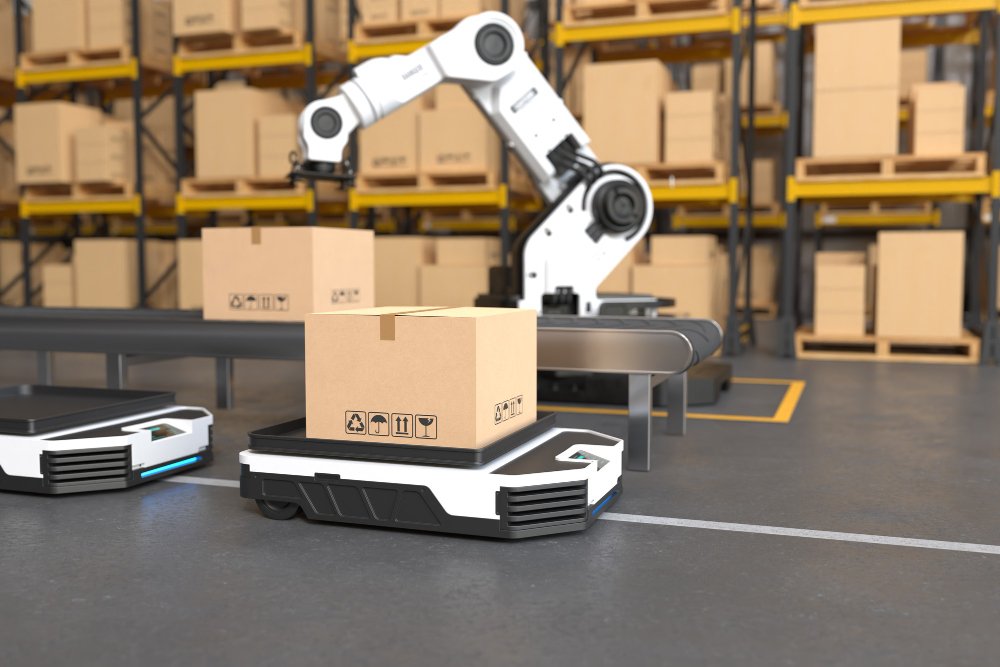
Automated material handling solutions are systems designed to move, store, sort, or manage materials with minimal human intervention.
Unlike traditional manual handling methods, automated systems use programmed control logic and industrial equipment to perform repetitive transportation and handling tasks accurately and consistently.
Common examples include:
- Automated conveyor systems
- Robotic pick-and-place systems
- Automated guided vehicles (AGVs)
- Autonomous mobile robots (AMRs)
- Automated storage and retrieval systems
- Robotic palletizing systems
- Sorting and packaging automation
- Sensor-based material tracking systems
These systems are commonly used in industries such as:
- Automotive manufacturing
- Food and beverage production
- Electronics manufacturing
- Pharmaceuticals
- Warehousing and logistics
- Consumer goods
- Industrial equipment manufacturing
The objective is simple:
Move materials faster, safer, and more efficiently while reducing unnecessary manual effort.
Why Material Handling Is Critical for Manufacturing Efficiency
Many manufacturers focus on improving production machines but overlook the impact of inefficient material flow.
A production line can have advanced equipment, but if materials are not available at the right place and right time, productivity suffers.
Common material handling problems include:
- Production delays due to missing components
- Excessive movement between workstations
- Manual transportation bottlenecks
- Increased labor requirements
- Workplace safety risks
- Poor inventory visibility
- Inconsistent production flow
Automated material handling systems address these challenges by creating a structured and predictable movement process.
When materials move efficiently, the entire manufacturing operation becomes more productive.
1. Increased Production Speed and Throughput
One of the biggest advantages of automated material handling solutions is improved production speed.
Manual transportation often creates delays because workers must:
- Collect materials
- Move products between stations
- Coordinate with other teams
- Wait for equipment availability
Automation allows materials to move continuously according to production requirements.
For example:
A conveyor system can automatically transfer products between assembly stations without waiting for manual handling.
A robotic system can repeatedly perform loading and unloading tasks with consistent speed.
An AGV can transport materials across a factory floor based on programmed routes.
The result is:
- Faster production cycles
- Reduced waiting time
- Higher output capacity
- Better utilization of manufacturing equipment
DevoForge’s industrial automation solutions focus on improving production flow by connecting equipment, control systems, sensors, and automation logic according to actual factory requirements.
2. Reduction of Manual Labor and Operational Costs
Manufacturers often spend significant resources on repetitive material movement tasks.
Employees performing repetitive handling activities may spend valuable time on transportation instead of higher-value production activities.
Automated material handling helps reduce dependency on manual movement by handling repetitive operations automatically.
Benefits include:
- Lower labor requirements for repetitive tasks
- Reduced operational expenses
- Better workforce utilization
- Increased focus on skilled activities
However, automation is not simply about replacing workers.
The goal is to allow employees to focus on tasks that require:
- Decision-making
- Quality control
- Maintenance
- Process improvement
- Production management
3. Improved Workplace Safety
Material handling can involve risks such as:
- Heavy lifting
- Moving equipment
- Repetitive strain injuries
- Forklift-related accidents
- Unsafe transportation routes
Automation improves workplace safety by reducing human involvement in hazardous tasks.
Examples:
- Automated conveyors can move heavy products safely.
- Robotic systems can handle dangerous materials.
- Automated vehicles can transport loads through predefined paths.
A safer production environment leads to:
- Fewer workplace incidents
- Reduced downtime
- Better employee productivity
4. Better Accuracy and Reduced Human Errors
Human errors during material movement can affect the entire production process.
Examples include:
- Incorrect component placement
- Wrong inventory movement
- Product damage
- Delayed supply to production stations
Automated systems follow programmed instructions, improving consistency and accuracy.
Sensors and control systems can monitor:
- Product position
- Movement timing
- Quantity tracking
- Production status
This creates a more reliable manufacturing process with fewer disruptions.
5. Improved Production Line Balance
A common manufacturing challenge is uneven workflow between different production stages.
One station may operate faster while another becomes a bottleneck.
Automated material handling systems help balance production by controlling how materials move between processes.
For example:
If an assembly station requires components every 30 seconds, the automated system can deliver materials according to that exact requirement.
This creates:
- Smoother production flow
- Reduced waiting periods
- Better machine utilization
- Improved overall efficiency
6. Real-Time Monitoring and Data Visibility
Modern automated material handling systems can collect valuable operational data.
By connecting sensors, controllers, and monitoring systems, manufacturers can understand:
- Material movement patterns
- Equipment utilization
- Production delays
- System performance
- Maintenance requirements
This information helps companies make better operational decisions.
When combined with industrial IoT and intelligent automation technologies, manufacturers can move toward smarter factories with improved visibility and control.
DevoForge also develops IoT and automation solutions that help businesses monitor and optimize connected systems.
7. Supports Smart Manufacturing and Industry 4.0
Modern factories are moving toward Industry 4.0, where machines, sensors, software, and automation systems work together.
Automated material handling is an important part of this transformation.
Connected handling systems can communicate with:
- PLC controllers
- Manufacturing execution systems (MES)
- ERP platforms
- IoT platforms
- Production monitoring systems
This enables:
- Automated decision-making
- Better resource planning
- Predictive improvements
- More flexible production
The future of manufacturing is not only automation.
It is intelligent automation.
8. Better Scalability for Growing Businesses
Manufacturing requirements change as companies grow.
A manual material handling process that works for a small production volume may become inefficient when demand increases.
Automated systems provide scalability by allowing manufacturers to:
- Increase production capacity
- Add new workstations
- Expand production lines
- Improve workflow without major redesign
A well-designed automation system supports future growth rather than creating limitations.
Key Components of an Automated Material Handling System
A complete automated material handling solution usually includes multiple technologies working together.
Sensors
Sensors detect:
- Product position
- Movement
- Presence
- Distance
- Environmental conditions
Controllers and PLC Systems
Controllers manage:
- Machine operations
- Timing sequences
- Communication between devices
- Automation logic
Actuators and Motion Systems
These components control:
- Movement
- Lifting
- Sorting
- Positioning
Human Machine Interfaces (HMIs)
HMIs allow operators to:
- Monitor systems
- Adjust parameters
- Identify problems
- Control operations
Industrial Communication
Communication networks allow machines and systems to exchange information reliably.
Challenges to Consider Before Implementing Automation
Although automation provides significant benefits, successful implementation requires proper planning.
Manufacturers should consider:
Existing Process Evaluation
Before automation, companies should analyze:
- Current workflow
- Production bottlenecks
- Material movement patterns
- Future requirements
System Integration
Automation systems must work with:
- Existing machinery
- Production software
- Control systems
- Safety requirements
Maintenance Planning
Long-term reliability requires:
- Proper documentation
- Maintenance strategy
- Component availability
- Technical support
Return on Investment
The right automation solution should provide measurable improvements in:
- Productivity
- Efficiency
- Safety
- Operational cost reduction
How to Choose the Right Automated Material Handling Solution
Every factory has different requirements.
The best solution depends on:
- Material type
- Production volume
- Factory layout
- Required speed
- Safety requirements
- Integration needs
- Future expansion plans
Before selecting an automation partner, manufacturers should evaluate:
- Engineering experience
- Industrial integration capability
- Understanding of production processes
- Ability to customize solutions
- Support after implementation
A successful automation project is not just about installing equipment.
It is about designing a system that improves the complete manufacturing workflow.
How DevoForge Helps Improve Manufacturing Efficiency Through Automation
DevoForge designs industrial automation solutions focused on improving production performance, reducing bottlenecks, and creating reliable manufacturing workflows.
Our automation approach includes:
- Automated material handling systems
- Industrial automation integration
- Control system development
- Sensor and actuator integration
- Machine interfacing
- Embedded automation solutions
By combining automation engineering, embedded systems, and intelligent control technologies, DevoForge helps businesses create efficient and scalable manufacturing operations.
Explore related services:
- Industrial Automation Services
- AI & Automation Solutions
- Embedded Systems Development Services
- Engineering & System Architecture Services
Related DevoForge Resources
You may also find these articles useful:
How to Integrate Automated Material Handling Systems with Existing Production Lines
Learn how manufacturers can connect automated handling systems with existing factory workflows.
Process Automation Consulting: How to Identify the Right Processes to Automate
Understand which manufacturing processes provide the highest automation opportunities.
How Machine Learning Solutions Improve Predictive Maintenance in Industrial Equipment
Explore how intelligent systems help reduce downtime and improve equipment reliability.
Final Thoughts
Automated material handling solutions are becoming an essential part of modern manufacturing because they improve speed, accuracy, safety, and operational efficiency.
For companies competing in today’s manufacturing environment, efficient material movement is no longer just an operational improvement—it is a strategic advantage.
The right automation approach can help manufacturers reduce bottlenecks, improve production consistency, lower operational costs, and prepare their factories for future growth. By combining smart automation technologies with proper engineering design, businesses can build manufacturing systems that are faster, safer, and ready for the demands of tomorrow.