Building an IoT product is not just about connecting hardware to the internet—it’s about designing a secure, scalable, and production-ready system that can evolve with your business. Choosing the wrong partner can lead to delays, security risks, rising costs, or even complete product failure.
In this guide, we’ll explain how to choose the right custom IoT development company, what to look for, what questions to ask, and how to avoid common mistakes—so you can confidently bring your IoT product to market.
Why Choosing the Right IoT Development Partner Matters
IoT projects are inherently complex. They involve:
- Embedded hardware and firmware
- Cloud infrastructure and APIs
- Web and mobile applications
- Security, data privacy, and compliance
- Manufacturing and lifecycle support
Unlike traditional software vendors, custom IoT development companies must handle both physical and digital systems. A gap in any layer can jeopardize the entire product.
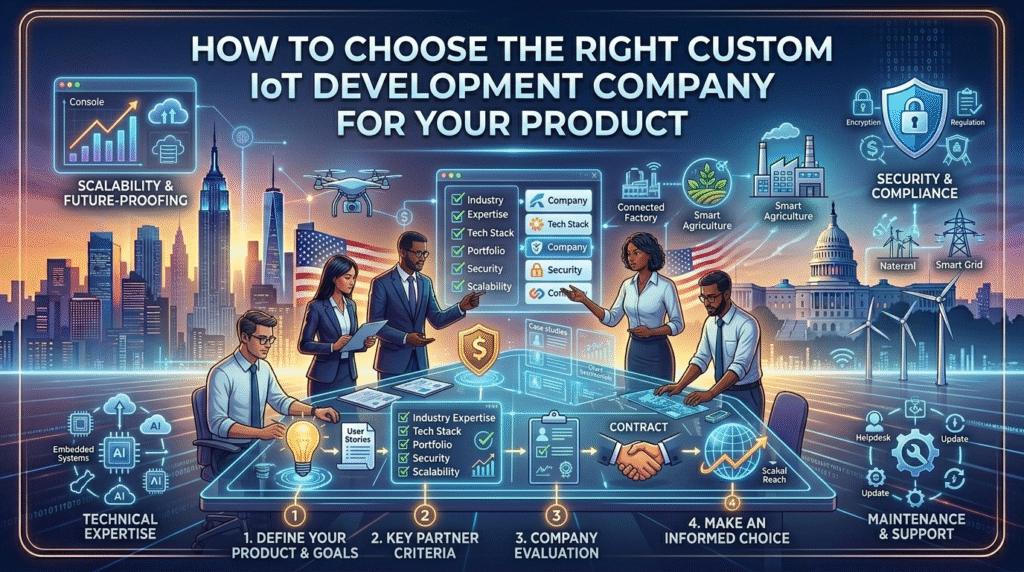
Step 1: Evaluate End-to-End IoT Capabilities
The first thing to assess is whether the company can deliver end-to-end IoT development, not just one piece of the puzzle.
A Reliable IoT Partner Should Cover:
- Product research and concept design
- Embedded systems development
- Firmware and RTOS design
- IoT app and cloud backend development
- Device management platforms
- AI and automation integration
- Manufacturing and production support
Many IoT app development companies only focus on dashboards or mobile apps. That’s fine for software-only projects—but risky for real-world IoT products.
Step 2: Assess Hardware & Embedded Systems Expertise
Hardware mistakes are expensive and hard to fix after production.
What to Look For:
- Experience with MCUs, MPUs, and SoCs
- Sensor and connectivity integration
- Power optimization and thermal design
- Secure bootloaders and OTA updates
- Proven embedded systems development process
A strong custom IoT development company will design hardware with scalability and manufacturing in mind—not just prototyping.
Step 3: Review IoT Software & App Development Experience
Modern IoT products rely heavily on software.
Key Software Capabilities:
- Cloud architecture (AWS, Azure, GCP, or custom)
- Real-time data ingestion and processing
- Web and mobile IoT applications
- APIs for third-party integrations
- Analytics and reporting dashboards
Top IoT application development companies don’t just build apps—they design systems that scale from 10 devices to 100,000+ devices.
Step 4: Device Management Platform Expertise Is Critical
Device management is often underestimated—but it determines long-term success.
Ensure the Company Can Deliver:
- Secure device provisioning
- Remote monitoring and diagnostics
- Firmware over-the-air (FOTA) updates
- Role-based access control
- Alerts and automation rules
If your product will scale, your partner must understand the best remote IoT device management platform architecture—or build a custom one when off-the-shelf tools fall short.
Step 5: Check Experience with Real-World IoT Use Cases
Ask for concrete examples—not buzzwords.
Strong Signals of Expertise:
- Industry-specific IoT projects
- Clear examples of IoT devices built and deployed
- Experience in industrial, medical, automotive, or consumer IoT
- Knowledge of compliance and certifications
Real examples of IoT devices show whether a company understands field conditions, not just lab demos.
Step 6: Evaluate Security & Compliance Approach
Security is non-negotiable in IoT.
Ask About:
- Device authentication and encryption
- Secure communication protocols
- Cloud security architecture
- Data privacy and compliance readiness
A professional custom IoT development company embeds security from architecture to firmware, not as an afterthought.
Step 7: Manufacturing & Supply Chain Support
Many IoT products fail between prototype and production.
A Strong Partner Will Support:
- BOM optimization
- Design for Manufacturing (DFM)
- Production test firmware
- Supplier coordination
- Quality assurance processes
This is especially important if you’re targeting mass production or global deployment.
Step 8: Geographic & Market Experience (USA Focus)
If you’re targeting the US market, experience matters.
Why It Helps:
- Understanding of US compliance standards
- Familiarity with enterprise expectations
- Alignment with US time zones and workflows
Companies offering IoT software development services in the USA (or with strong US-facing experience) often deliver smoother enterprise engagements.
Step 9: Ask the Right Questions Before You Decide
Here are a few must-ask questions:
- Have you built production-scale IoT devices before?
- Can you support us from prototype to manufacturing?
- Do you offer custom device management platforms?
- How do you handle scalability and security?
- What happens after product launch?
The quality of answers often reveals more than a portfolio.
Common Red Flags to Avoid
🚩 Only software or only hardware expertise
🚩 No real production or deployment experience
🚩 Over-reliance on off-the-shelf platforms
🚩 Lack of documentation and system ownership
🚩 No post-launch support strategy
Why Companies Choose a Custom IoT Development Partner
Custom IoT development offers:
- Tailored architecture for your use case
- Better performance and security
- Easier scalability
- Lower long-term cost
- Full ownership of IP and data
At DevoForge, we specialize in custom IoT development, combining embedded systems, cloud platforms, AI automation, and manufacturing support to help companies turn ideas into scalable products.
Final Thoughts
Choosing the right custom IoT development company is one of the most important decisions in your product journey. The right partner doesn’t just write code or design hardware—they help you build a future-ready IoT product that scales, performs, and delivers real business value.
If you’re evaluating IoT partners, focus on end-to-end capability, real-world experience, scalability, and long-term support—not just price.