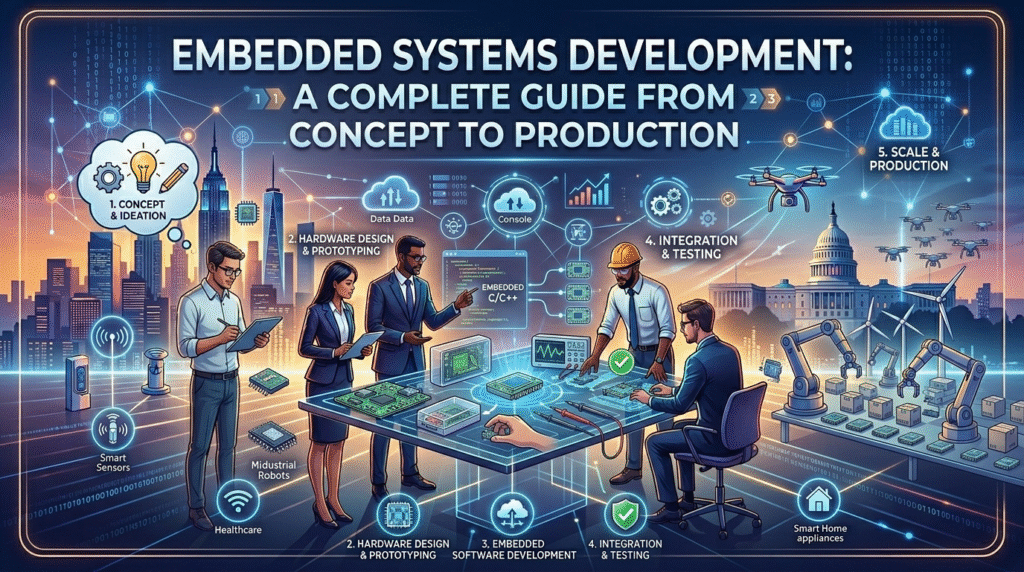
Embedded systems are at the core of modern technology—powering everything from smart consumer devices and industrial automation systems to medical equipment and connected IoT products. As products become smarter and more connected, embedded systems development has evolved into a multidisciplinary engineering discipline that blends hardware, firmware, software, cloud, and manufacturing expertise.
This guide provides a complete, end-to-end overview of embedded systems development, covering the entire journey—from concept and architecture to prototyping, validation, and production-ready deployment.
What Is Embedded Systems Development?
Embedded systems development is the process of designing and building dedicated computing systems that are integrated into larger products to perform specific functions. Unlike general-purpose computers, embedded systems are optimized for:
- Reliability
- Real-time performance
- Low power consumption
- Cost efficiency
- Long-term stability
These systems typically consist of microcontrollers or processors, firmware, sensors, actuators, and communication interfaces.
Where Embedded Systems Are Used Today
Embedded systems form the backbone of multiple industries:
- IoT & Smart Devices – Sensors, gateways, wearables
- Industrial Automation – PLCs, motor controllers, HMIs
- Medical Devices – Patient monitoring, diagnostics equipment
- Automotive Systems – ECUs, ADAS modules, telematics
- Consumer Electronics – Smart appliances, audio systems
As products evolve, embedded systems increasingly integrate cloud connectivity, AI, and automation, making professional development more critical than ever.
Phase 1: Product Concept & Requirements Definition
Every successful embedded product begins with a well-defined concept.
Key Activities in This Phase:
- Problem identification and use-case definition
- Functional and non-functional requirements
- Environmental and regulatory constraints
- Cost and production volume targets
At DevoForge, this phase aligns business goals with engineering feasibility, ensuring the product is scalable and production-ready from day one.
Phase 2: Embedded System Architecture Design
System architecture is the foundation of embedded systems development.
Core Architectural Elements:
- Processing Unit – MCU, MPU, or SoC selection
- Memory – Flash, RAM, external storage
- Power Management – Battery, DC input, power optimization
- Peripherals – Sensors, displays, motors, communication modules
- Interfaces – SPI, I2C, UART, CAN, USB, Ethernet
A robust architecture ensures long-term reliability, easier firmware updates, and smoother manufacturing transitions.
Phase 3: Hardware Design & Component Selection
Hardware design directly impacts performance, cost, and manufacturability.
Key Considerations:
- Component availability and lifecycle
- EMI/EMC compliance
- Thermal performance
- PCB layout optimization
- Design for Manufacturing (DFM)
This phase transforms architectural decisions into production-grade schematics and PCB designs.
Phase 4: Firmware & Embedded Software Development
Firmware is the intelligence of the embedded system.
Firmware Responsibilities:
- Hardware initialization
- Sensor data acquisition
- Communication protocol handling
- Real-time task scheduling
- Power optimization
- Error detection and recovery
Depending on complexity, developers may use bare-metal programming or RTOS-based designs. Secure bootloaders and OTA update mechanisms are increasingly standard for connected products.
Phase 5: Embedded System Development Tools
Professional embedded systems development relies heavily on specialized tools.
Common Embedded System Development Tools:
- IDEs & Toolchains – ARM GCC, IAR, Keil
- Debugging Tools – JTAG, SWD, logic analyzers
- RTOS Platforms – FreeRTOS, Zephyr, ThreadX
- Version Control – Git-based workflows
- Testing Tools – Unit testing, HIL testing
Choosing the right embedded system development tools improves development speed, code quality, and long-term maintainability.
Phase 6: Prototyping & Functional Validation
Prototyping bridges the gap between design and real-world usage.
Validation Activities:
- Functional testing
- Stress and endurance testing
- Environmental testing
- Communication reliability checks
- Power consumption profiling
This phase ensures the system behaves reliably under real operating conditions.
Phase 7: System Integration & Connectivity
Modern embedded systems rarely operate in isolation.
Integration Scope:
- IoT cloud platforms
- Mobile or web applications
- Enterprise systems (ERP, MES, CRM)
- AI and automation engines
Secure communication protocols, encryption, and authentication are critical at this stage—especially for connected and industrial products.
Phase 8: Manufacturing Readiness & Production Support
Transitioning from prototype to mass production is one of the most challenging steps.
Manufacturing Support Includes:
- BOM optimization and cost reduction
- Production test firmware
- Test jigs and fixtures
- Supplier coordination
- Yield improvement strategies
Production-ready embedded systems are designed not just to work—but to be manufactured reliably at scale.
Common Challenges in Embedded Systems Development
- Component shortages and lifecycle risks
- Power and thermal constraints
- Real-time performance issues
- Firmware complexity and maintainability
- Security vulnerabilities
Partnering with an experienced embedded systems development team helps mitigate these risks early.
Why Choose a Custom Embedded Systems Development Partner?
Off-the-shelf solutions rarely fit complex or innovative products.
A custom embedded systems development partner offers:
- End-to-end product ownership
- Faster iteration cycles
- Scalable and secure architecture
- Manufacturing-aligned designs
- Long-term technical support
At DevoForge, we combine deep embedded expertise with system-level thinking—helping companies move confidently from concept to production.
Final Thoughts
Embedded systems development is no longer just about hardware and firmware—it’s about building intelligent, connected, and scalable products. From early concept design and architecture to firmware, validation, and manufacturing support, each phase plays a critical role in product success.
Whether you’re building a smart IoT device, industrial controller, or next-generation electronic product, a structured and professional embedded development approach is the key to long-term success.