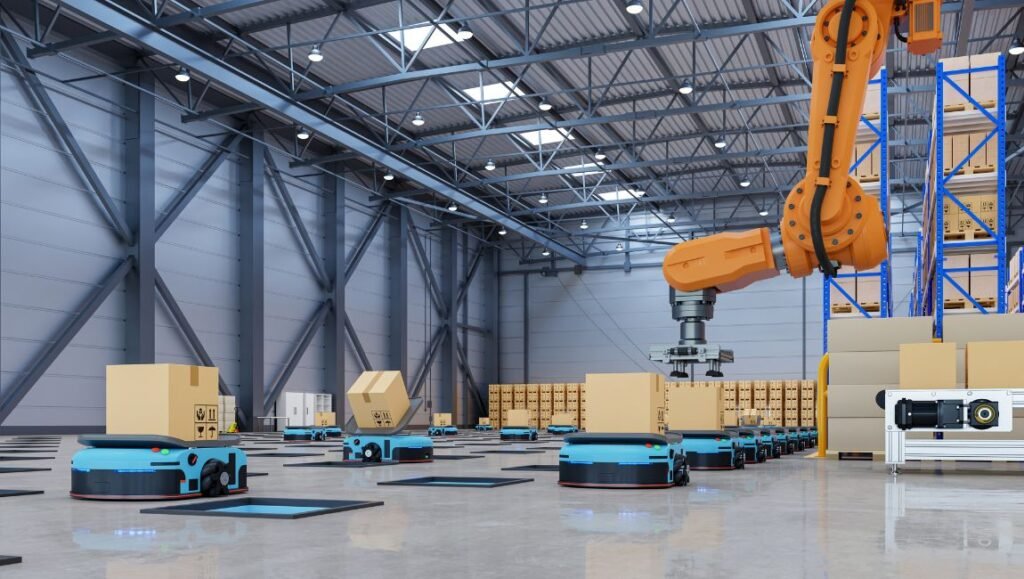
In many factories, warehouses, and production facilities, the biggest problems are not always caused by a lack of workers or machines. More often, the real issue is poor coordination between people, equipment, materials, and data.
A product may be ready for the next stage, but the material is still waiting to be moved. A machine may be running, but no one has real-time visibility into its performance. A warehouse may have enough stock, but picking, sorting, and handling are still slow because too much depends on manual work.
This is where industrial automation services and automated material handling solutions can make a major difference.
For businesses that want to improve productivity, reduce downtime, increase safety, and scale operations, automation is no longer just an option. It is becoming a practical requirement.
At DevoForge, we help businesses design and develop smart automation systems that connect machines, sensors, controllers, software, and material handling equipment into one reliable workflow.
What Are Industrial Automation Services?
Industrial automation services involve the design, development, installation, and integration of systems that control industrial processes with minimal manual intervention.
In simple words, industrial automation helps machines and systems perform repetitive, time-sensitive, or high-precision tasks more efficiently.
These services may include:
- PLC programming
- HMI and SCADA development
- Sensor integration
- Machine control systems
- Industrial IoT solutions
- Conveyor control systems
- Robotic automation
- Process automation
- Data monitoring dashboards
- Remote machine monitoring
- Predictive maintenance systems
- Custom embedded control systems
The goal is not only to replace manual work. The real goal is to make the entire operation more accurate, safer, faster, and easier to manage.
A well-designed automation system gives business owners and plant managers better control over production, material movement, machine health, and operational performance.
What Are Automated Material Handling Solutions?
Automated material handling solutions are systems designed to move, sort, lift, store, track, or manage materials with less manual effort.
These solutions are commonly used in:
- Manufacturing plants
- Warehouses
- Distribution centers
- Packaging lines
- Food processing facilities
- Automotive industries
- Pharmaceutical production
- Logistics operations
- Assembly lines
- E-commerce fulfillment centers
Examples of automated material handling systems include:
- Conveyor systems
- Automated sorting systems
- Robotic pick-and-place systems
- Automated guided vehicles
- Smart storage and retrieval systems
- Barcode and RFID tracking systems
- Weighing and counting automation
- Pallet handling systems
- Packaging and labeling automation
- Sensor-based material flow control
When these systems are properly designed, they reduce delays, improve worker safety, and create a smoother flow of materials from one stage to another.
Why Businesses Are Moving Toward Automation
Manual processes can work well when production volume is low. But as demand grows, manual handling often becomes slow, inconsistent, and difficult to control.
Common problems include:
- Delayed production flow
- Human error in counting, sorting, or tracking
- Unsafe lifting or repetitive manual tasks
- Poor visibility of machine performance
- High labor dependency
- Inconsistent product quality
- Material bottlenecks
- Downtime caused by slow decision-making
- Difficulty scaling production
Automation helps solve these problems by creating a system that works with accuracy and consistency.
For example, instead of workers manually moving materials from one machine to another, an automated conveyor system can transfer them at the right speed and time. Instead of manually checking machine status, sensors can send live data to a monitoring dashboard. Instead of waiting for breakdowns, smart systems can detect early warning signs before a failure happens.
This is the real value of modern factory automation.
How Industrial Automation Improves Productivity
Productivity is not only about working faster. It is about reducing wasted time, unnecessary movement, machine idle time, and repeated manual effort.
With professional industrial automation services, businesses can improve productivity in several ways:
1. Faster Production Cycles
Automated systems can perform repetitive actions continuously and accurately. This reduces waiting time between production stages and helps maintain a steady workflow.
2. Better Machine Utilization
Automation makes it easier to monitor machine status, production speed, and downtime. This helps managers identify underused equipment and improve overall machine performance.
3. Reduced Human Error
Manual handling, data entry, and inspection can lead to mistakes. Automation reduces these errors by using sensors, controllers, and software-based checks.
4. Improved Quality Control
Automated inspection systems, sensor-based measurements, and real-time alerts help maintain consistent product quality.
5. Better Use of Labor
Workers can be moved from repetitive manual tasks to more valuable roles such as supervision, quality control, maintenance, and process improvement.
Safety Benefits of Automated Material Handling
Material handling is one of the most physically demanding parts of industrial work. Lifting, carrying, pushing, pulling, and repetitive motion can create safety risks.
Automated material handling solutions help reduce these risks by minimizing direct human involvement in heavy or repetitive tasks.
Automation can help prevent:
- Manual lifting injuries
- Slips and trips during material movement
- Accidents near moving equipment
- Fatigue-related mistakes
- Unsafe interaction with heavy loads
- Exposure to hazardous production areas
A smart material handling system can include emergency stop buttons, safety sensors, light curtains, alarms, access control, and machine guarding. These features protect workers while keeping the operation efficient.
For many companies, safety improvement alone is a strong reason to invest in automation.
The Role of PLC, Sensors, and Industrial IoT
Modern automation depends on the right combination of hardware and software.
A typical system may include:
- PLCs to control machines and processes
- Sensors to detect position, weight, temperature, pressure, speed, or movement
- HMIs to allow operators to control and monitor machines
- SCADA systems for larger process visualization
- Industrial IoT devices for remote monitoring and data collection
- Cloud dashboards for reporting and analytics
- Embedded systems for custom machine control
For example, in a material handling line, sensors can detect when a package arrives. A PLC can then activate a conveyor, control a diverter, trigger a weighing system, and send production data to a dashboard.
This is how automation turns individual machines into a connected, intelligent system.
Custom Automation vs. Ready-Made Automation
Many businesses start by looking for ready-made automation equipment. In some cases, this works. But in many industrial environments, every workflow has its own layout, speed, product size, safety requirement, and integration challenge.
That is why custom automation is often the better choice.
A custom automation solution can be designed around:
- Your existing machines
- Your floor layout
- Your production speed
- Your material type
- Your safety requirements
- Your reporting needs
- Your future expansion plans
- Your budget
At DevoForge, we focus on building automation systems that match the real workflow of the business. This may involve PLC programming, PCB design, embedded firmware, IoT connectivity, custom dashboards, sensor integration, or complete control system development.