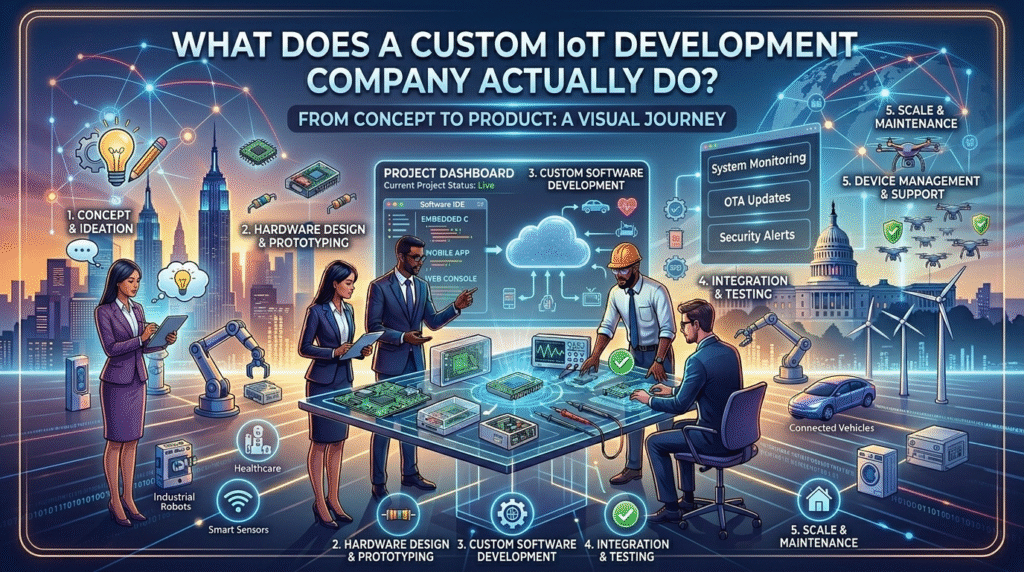
As the Internet of Things continues to reshape industries, many businesses recognize the value of connected products—but struggle to understand what a custom IoT development company actually does and how such a partner fits into their product strategy.
Is it just hardware? Is it software? Or something more?
In reality, a custom IoT development company delivers end-to-end product engineering, helping businesses transform ideas into secure, scalable, and production-ready IoT solutions. This guide breaks down the full scope of services, responsibilities, and real business value such companies provide.
The Role of a Custom IoT Development Company
A custom IoT development company is responsible for designing, building, and scaling connected products tailored to specific business needs—not generic, off-the-shelf solutions.
Unlike standard IoT app development companies or hardware vendors, custom IoT partners take ownership of the entire system, including:
- Embedded hardware and firmware
- Cloud and IoT software platforms
- Web and mobile applications
- Device management systems
- AI, automation, and analytics
- Manufacturing and lifecycle support
Phase 1: Product Research & IoT Strategy
Every IoT product starts with a problem to solve.
What Happens in This Phase:
- Business and technical requirement analysis
- Use-case and workflow definition
- Feasibility studies
- Cost and scalability planning
- Compliance and regulatory considerations
A custom IoT development company ensures your idea is technically viable, commercially sound, and scalable before any development begins.
Phase 2: System Architecture & Engineering Design
Architecture decisions define long-term success.
Key Responsibilities:
- Hardware and connectivity selection
- Embedded system architecture
- Cloud and backend system design
- Data flow and API architecture
- Security and authentication models
This phase ensures all system layers—device, cloud, and application—work seamlessly together.
Phase 3: Embedded Systems & Firmware Development
At the core of every IoT product is embedded intelligence.
Embedded Development Includes:
- Microcontroller or processor selection
- Sensor and actuator integration
- Real-time firmware development
- Power optimization
- Secure bootloaders and OTA updates
Strong embedded systems expertise separates professional IoT development from hobby-level implementations.
Phase 4: IoT Software & Application Development
IoT software is what turns device data into actionable insight.
Software Services Include:
- Cloud backend development
- Real-time data processing
- Web and mobile IoT applications
- Dashboards and analytics
- API and third-party integrations
Many IoT application development companies focus only on this layer—but a custom IoT development company integrates it tightly with hardware and firmware.
Phase 5: Remote Device Management Platforms
One of the most critical responsibilities is long-term device management.
Platform Capabilities:
- Secure device provisioning
- Remote monitoring and diagnostics
- Firmware over-the-air (FOTA) updates
- Configuration management
- Alerts and automation
Whether integrating the best remote IoT device management platform or building a custom solution, this layer ensures reliability at scale.
Phase 6: Data Analytics, AI & Automation
Modern IoT solutions go beyond monitoring.
Advanced Capabilities:
- Predictive maintenance
- AI-based anomaly detection
- Automated decision workflows
- Intelligent alerts and controls
This is especially valuable for mid-market companies seeking AI and automation deployment without enterprise-level complexity.
Phase 7: Prototyping, Testing & Validation
Before deployment, systems must be validated under real-world conditions.
Testing Activities:
- Functional and stress testing
- Connectivity and latency testing
- Security validation
- Field trials and pilot deployments
This reduces failures and ensures product readiness.
Phase 8: Manufacturing & Production Support
Many IoT projects fail at scale due to manufacturing challenges.
Manufacturing Support Includes:
- BOM optimization
- Design for Manufacturing (DFM)
- Production test firmware
- Test fixtures and quality workflows
- Supplier coordination
A custom IoT development company ensures the product is manufacturable, cost-effective, and reliable.
Phase 9: Deployment, Scaling & Lifecycle Support
IoT products are long-term systems—not one-time builds.
Ongoing Responsibilities:
- Platform scaling
- Device fleet management
- Security updates
- Feature upgrades
- Performance optimization
This lifecycle approach protects your investment and enables growth.
When Do You Need a Custom IoT Development Company?
You typically need a custom IoT partner if:
- Your product involves both hardware and software
- Off-the-shelf IoT platforms don’t fit your use case
- You plan to scale beyond pilots
- Security, compliance, and reliability matter
- Manufacturing is part of the roadmap
Real-world examples of IoT devices—from industrial controllers to connected medical products—almost always require custom development.
Why Businesses Choose Custom IoT Over Generic Solutions
Custom IoT development offers:
- Tailored system architecture
- Better performance and scalability
- Full ownership of IP and data
- Lower long-term operational cost
- Flexibility for future features
A custom IoT development company becomes a strategic technology partner, not just a vendor.
How DevoForge Helps Businesses Build IoT Products
At DevoForge, we provide end-to-end custom IoT development, combining embedded systems, cloud platforms, AI automation, and manufacturing support.
Our approach focuses on:
- Product-first engineering
- Scalable and secure architecture
- Real-world deployment readiness
- Long-term partnership and support
Final Thoughts
So, what does a custom IoT development company actually do?
It designs, builds, deploys, and supports connected products from concept to production and beyond—ensuring your IoT solution is reliable, scalable, and aligned with your business goals.
If your IoT vision goes beyond simple connectivity, a custom IoT development partner is not optional—it’s essential.