As IoT deployments grow from a handful of devices to thousands—or even millions—managing them manually becomes impossible. This is where a remote IoT device management platform becomes critical.
Choosing the best remote IoT device management platform can determine whether your IoT product scales smoothly or struggles with downtime, security risks, and rising operational costs. In this guide, we’ll explain what these platforms do, their essential features, business benefits, and real-world use cases across industries.
What Is a Remote IoT Device Management Platform?
A remote IoT device management platform is software that enables businesses to monitor, configure, update, and secure connected devices remotely throughout their lifecycle.
It acts as the control center for:
- Connected devices in the field
- Firmware and software updates
- Device health and diagnostics
- Security and access management
For modern IoT products, device management is not optional—it’s foundational.
Why Device Management Is Critical for IoT Success
Without proper device management, IoT deployments face:
- Manual maintenance and high operational costs
- Security vulnerabilities
- Inconsistent device behavior
- Downtime and data loss
- Poor user experience
The best remote IoT device management software solves these challenges by centralizing control and automation.
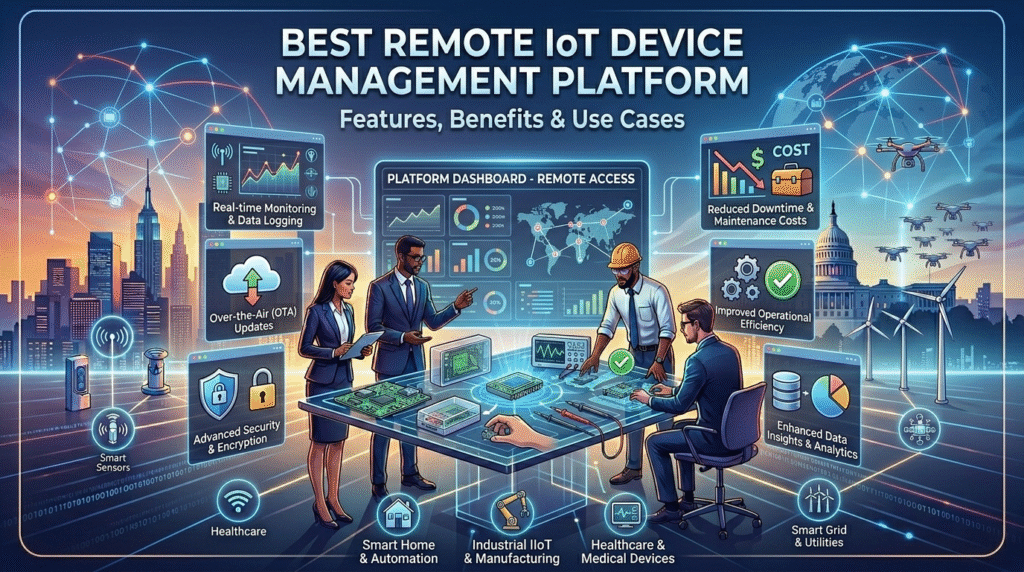
Core Features of the Best Remote IoT Device Management Platform
1. Secure Device Provisioning & Authentication
Every device must be securely identified and authenticated.
Key capabilities include:
- Unique device identities
- Certificate-based authentication
- Secure onboarding workflows
This prevents unauthorized access and protects sensitive data.
2. Remote Monitoring & Diagnostics
Continuous visibility into device health is essential.
Monitoring features include:
- Connectivity status
- Sensor and performance metrics
- Error and fault detection
- Real-time alerts
This allows teams to detect issues before they become failures.
3. Firmware Over-The-Air (FOTA) Updates
OTA updates are a defining feature of scalable IoT platforms.
Benefits of FOTA:
- Remote bug fixes
- Feature upgrades
- Security patch deployment
- Reduced on-site maintenance costs
A reliable OTA system is a hallmark of the best remote IoT device management platform.
4. Device Configuration & Control
Devices must be configurable post-deployment.
Configuration management includes:
- Remote parameter updates
- Mode switching
- Policy-based behavior
- Group-based control
This flexibility enables faster optimization and experimentation.
5. Security & Access Control
Security must be embedded at every layer.
Platform security features include:
- Encrypted communication
- Role-based access control
- Audit logs and activity tracking
- Secure key management
This is especially important for enterprise and regulated industries.
6. Scalability & Performance
The platform must scale with your product.
Scalability considerations:
- Support for thousands or millions of devices
- Cloud-native architecture
- High availability and fault tolerance
Scalability separates prototypes from production-ready IoT systems.
Benefits of Using a Remote IoT Device Management Platform
Implementing the right platform delivers measurable business value.
Key Benefits:
- Reduced operational and maintenance costs
- Faster issue resolution
- Improved device uptime
- Enhanced security and compliance
- Easier product scaling
These benefits make device management a core part of IoT software development services.
Common Use Cases Across Industries
Industrial IoT (IIoT)
- Remote monitoring of machinery
- Predictive maintenance
- Automated alerts for anomalies
Smart Healthcare
- Remote patient monitoring
- Device reliability and safety updates
- Compliance-ready data handling
Fleet & Asset Tracking
- Real-time location and health tracking
- Remote diagnostics
- Firmware updates without downtime
Smart Energy & Utilities
- Meter monitoring
- Demand response systems
- Grid optimization
These examples of IoT devices show how device management platforms enable real-world scalability.
Build vs Buy: Choosing the Right Device Management Platform
Many businesses evaluate off-the-shelf platforms—but not all products fit generic solutions.
When Off-the-Shelf Works:
- Small deployments
- Standard use cases
- Limited customization needs
When Custom Platforms Are Better:
- Industry-specific workflows
- Tight hardware-firmware integration
- Advanced automation and AI
- Long-term cost optimization
A custom IoT development company can help you decide whether to build, customize, or integrate existing platforms.
How Device Management Fits into the Full IoT Ecosystem
A device management platform works alongside:
- Embedded systems and firmware
- IoT cloud backend
- Web and mobile applications
- AI and automation engines
That’s why leading IoT application development companies treat device management as a core system component—not an add-on.
Why DevoForge Builds Scalable IoT Device Management Platforms
At DevoForge, we design and develop custom remote IoT device management platforms tailored to your product and market.
Our Approach Includes:
- Secure provisioning and OTA systems
- Cloud-native scalable architecture
- Deep embedded system integration
- Automation-ready workflows
- Long-term lifecycle support
We focus on building platforms that scale with your product—not limit it.
Final Thoughts
The best remote IoT device management platform is not just about monitoring devices—it’s about maintaining control, security, and scalability throughout the product lifecycle.
Whether you’re launching a new IoT product or scaling an existing deployment, investing in the right device management platform ensures reliability, reduces costs, and future-proofs your solution.